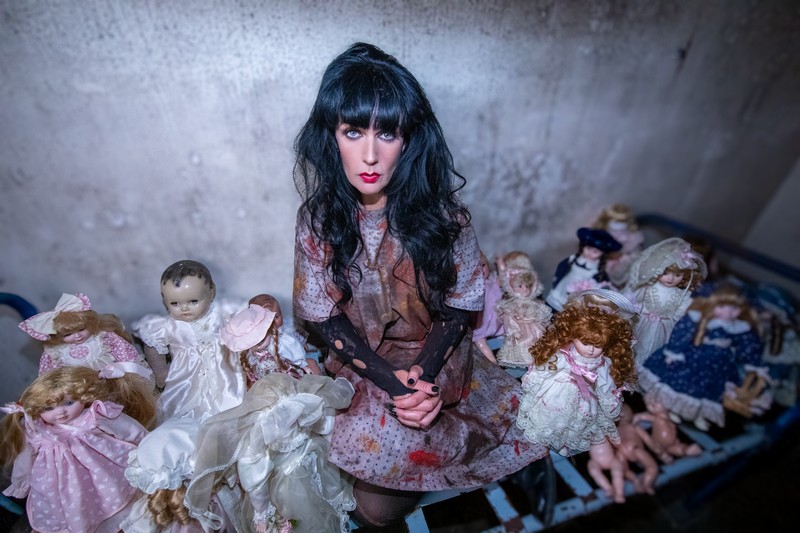
By: Quinn Que
Q) How did you first get into music, and what drew you to the alt-metal and theatrical rock genres?
A) I don’t think it was a conscious decision to go in the direction of any genre. For me, I’m very diverse in my music taste and there are different conflicting elements of my life that mean, musically, I have something to say. For me, my music is about storytelling, so I orchestrate the story of the song with different musical elements.
Q) You’ve been described as having similarities to Edgar Allan Poe and Sylvia Plath. Which literary and/or artistic voices do you believe have most shaped your dark, gothic aesthetic?
A) I love taking something that’s beautiful and reimagining it. There’s beauty in the dark and I love mixing aesthetics. I love the imagination of Tim Burton and Danny Elfman, taking people on a journey is important to me.
Q) Is it true that you married and divorced a Victorian ghost named Edwardo? How did the experience of that relationship impact your music and creative process?
A) As a songwriter, you write about everything that you are going through and when you have a powerful supernatural experience it’s very haunting but also very scary. I walked down the aisle to a song called “Haunted,” which I’d written about my encounters with Edwardo. For me, it helped me vocalize the challenges of dealing with a temperamental ghostly presence.
Q) Given your striking visual identity and theatrical performances, how important is the visual component to your overall artistic vision?
A) I have a very visual mind. When I’m songwriting, I see the visuals to a music video – it’s something in my mind that I can’t separate. I have a background as a fashion designer, so for me, clothes have always been an extension of who I am and I design a lot of my stage clothes. The dress in the “Last Supper” music video was designed by me and it has the song lyrics embroidered on the chest. I get obsessed with the details. I know some may think it’s shallow, but what you wear and how you present yourself can be so empowering, it’s an armor against the world and I love that.
Q) The music video features you being captured by grotesque pigs before breaking out, reclaiming your power. What inspired this particular visual metaphor?
A) Well, in the music video I actually end up with my head on a plate being devoured by an army of pigs, so I don’t see it as reclaiming any power sadly. Although, often an end can symbolize a new beginning. It’s open to interpretation as to who and what the pigs represent, but the video concept is quite sad really and touches on feeling trapped and wanting to break free.
Q) You describe the video’s ending as “a vegan dream.” What deeper meaning were you trying to convey with that imagery?
A) I think in some ways the video turns the tables on the human food chain. We have pigs devouring a human on a dinner table, the flip side of that would be considered a normal dinner. It’s about changing the perspective.
Q) The song explores themes of self-image, fame, and societal validation. What drew you to write the song in this way?
A) I felt very trapped and lost at the time. I had a fashion brand that was successful but very focused on celebrity and popular culture. The conversation became about which celebrity was wearing it and it felt uncreative, like I was trapped in a hamster wheel. It was like when you create a monster and you can’t control it, so it ends up consuming you and your identity. Something that was supposed to be a symbol of rebellion becomes a symbol of conformism and I grew to resent that.
Q) How do you balance the satirical commentary with the biblical references in “Last Supper?”
A) I just think the stories in The Bible are so powerful and visual and fascinating. I grew up going to Sunday School every week and these stories stayed with me. Regardless of religious beliefs, they are a brilliant topic and the subjects and lessons can be reinterpreted and reimagined in many ways.
Q) It seems like maturity has helped you reflect on your relationship with popular culture. How has your perspective on fame and social media evolved over the years?
A) I’m more grateful and I understand it, so I take it with a pinch of salt. It was a huge privilege to have such massive celebrities wearing my products. Social media is also a great tool and allows you to connect with your audience. You can create opportunities for yourself and that’s empowering. Of course, it has its dark side, but with maturity you can manage that.
Q) You’ve been working on dozens of new tracks. What can audiences expect from your upcoming music?
A) There’s some absolutely crazy stuff in the pipeline and I can’t wait to unleash it. As a writer now, I’m beginning to show my vulnerable side without as much angst and that’s quite liberating. But as an artist, you’re always one step ahead – what you’re currently working on is different from what you’re releasing. You have to focus on what people can hear; otherwise, it’s a bit like keeping secrets from your audience.
Q) With new releases planned for August and throughout the fall, how do you see your sound evolving from “Last Supper” and “Identity Theft?”
A) I think, naturally, you evolve as a human every day. As a writer, you have new things to say and your work takes on a new perspective. How that translates is for the listener to decide.
Q) You’re a regular presence at horror and music festivals. How does that face-to-face connection with fans influence your creative process?
A) It’s actually an honor to meet my audience. I am always blown away by how kind people are – it shocks me a little bit. Also, people love to share their personal stories with me and ghost stories – it’s a brilliant feeling. There are a few interactions that I’ve had that have frightened me. I won’t go into detail, but some advice for anyone, even if you’re not in the public eye: never post your exact location if you’re still there – it’s dangerous.
Q) What would you like to say to your fans and supporters?
A) Firstly, thank you. If you’re a misfit like me, that feeling of acceptance means a lot. I really just want to empower people to live their truth and feel free in who they are. Not everybody will love you, but that’s OK, you’ll find your people and that’s powerful.