By: Malasha Parker
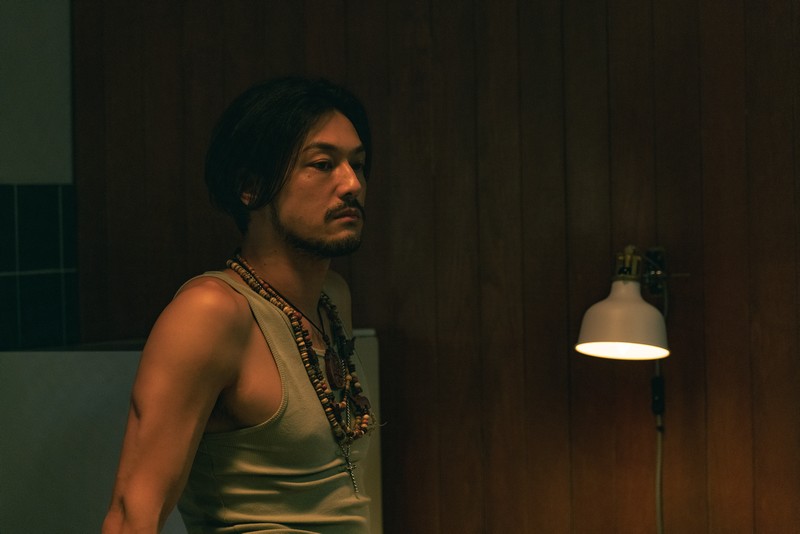
Q) How was your character Wing originally described to you in TAPE?
A) Actually, back in my Blockbuster splurging days, I had seen the 2001 version of TAPE, directed by Richard Linklater. When Bizhan [Tong], our director, mentioned that we were redoing the film and that I might be considered for either Wing or Jon, I was absolutely over the moon. Of course, I didn’t get the role right away—I had to audition for it first. Still, while I was auditioning for Jon at first, my heart was truly hoping for a twist of fate that would allow me to play Wing. When I was offer the role of Wing, I felt a real sense of achievement. It’s very rare for me to audition for a role and not get what I want, so I’m ecstatic to have played such a central role in this extremely experimental film.
Q)How did you receive the role of Wing, and what made it so important to play this role at this time?
A) For me, the role of Wing was about proving that I could speak Cantonese like a local. Cantonese is a language that I properly learned almost ten years ago and I was never too confident with this elusive dialect. While I’m sure a native speaker might notice some flaws in my depiction, and it’s not a totally perfect performance, it was a huge milestone for me as a boy who grew up in Australia speaking mainly English. I’m very proud of myself for being able to complete the heavy dialogue as Wing. But that’s the technical side. I believe Wing carries a significant voice for the audience—a voice for those who don’t have one. Many people who encounter unfortunate situations, who find themselves victims of something horrible, often don’t get a chance to speak about it. Wing shows that even years after an incident, you can still ask questions, inquire, and seek a better understanding of what happened. Often when something is in the past people tell you to forget about it. Wing demonstrates that as long as your questions still burn, answers can be found and that justice can be pursued.
Q) What was the research process like for you to better understand your character and his actions?
A) My first inclination was to look into similar cases of assault on adults and even minors. However, the time from when I received the script to when we had to perform it on set was very tight. In Hong Kong many miracles can happen when you are aware we’re only filming for six days for the entire film. There was a lot of dialogue to digest. A big part of the project involved rehearsing with my fellow cast members, which was quite difficult at the time because of COVID-19. Many of our rehearsals were done over Zoom and, when you’re rehearsing that way, it’s really hard to get off script. Fortunately, when the restrictions were lifted we were able to meet in person and start adding “blocking” the performance. As I began to understand where I’d be standing and what props would be beside me, the script suddenly made more sense and I could remember my lines much better than when I was sitting in front of a computer. I’ve never rehearsed my lines as much for any film or TV series before. Given how much dialogue there is, plus the fact that everything is in Cantonese, I needed to put in as much hard work as I could because I didn’t want to let the team down. We had a great team; Selena [Lee] and Kenny [Kwan] are both really famous in Hong Kong. I just wanted to make sure I pulled my weight in this extremely challenging project.
Q) How do you think Bizhan Tong’s reimagining of the original TAPE film differs and enhances his version for 2024/2025 audiences?
A) I think in a Western context, Tape is already a profoundly memorable story with a great script and performances by Ethan Hawke, Uma Thurman and Robert Sean Leonard. However, when the story is transformed into Cantonese, it becomes much more taboo. Conflicts within Asian cultures are typically dealt with in a more subtle and less invasive manner. I say “usually” because there are certainly examples of big arguments and invasive inquiries, of course. But generally speaking, it’s purposely avoided. That’s why I believe Stephen Belber’s script allows the audience to gain rare insight into a Cantonese argument—lines of inquiry that don’t often occur in Asian films. To my understanding, in Hong Kong people do their best to avoid these types of arguments or, even if they do occur, they are kept in very private situations so that no one else will see.
This film offers an opportunity to get an MRI into a domestic inquiry that is heated, intrusive and layered with multilayers of complexity. It’s not just a revelation of each character’s truths and lies; this film provides an x-ray into Hong Kong Cantonese culture itself. In the context of the original English script, this reimagination offers a rare glimpse into the depth of another culture. It is a writer and director’s dream to bring new relevance into a tested stage performance.
Q) In what ways does the relationship between Wing and Jon set the tone for the second act of the movie when Amy enters the room?
A) Well, I think in the beginning of the film, Wing and Jon appear to be the best of friends. The audience may even be fooled into thinking it’s just two friends catching up—perhaps having a smoke, a couple of beers and enjoying a good time. But that’s where Stephen Belber’s script hooks you in. By the time Amy comes in, the audience believes certain things have happened, leaving little room for their own thought trajectory. However, when Amy enters, the winds of change blow through those doors. The air in the room thickens further and all bets are off. That’s why I think Amy isn’t just designed to be a very intelligent character; she changes the whole playing field. Hopefully, without revealing too much about the film. From being the victim, she becomes the puppet master – a dynamic moment in the film, very reminiscent of Fight Club. It’s a great script to have been a part of and I believe the whole story is intellectual and filled with layers of deceit, treachery, and discovery; that will leave the audience guessing and questioning.
Q) Is there a particular scene that you found the most challenging to film—either emotionally or physically?
A) There were definitely many emotionally difficult scenes, but one story I’ll share with you is when you see Wing blowing smoke rings. For those who are familiar with cigars, the smoke is very heavy, making it quite easy to blow smoke rings with your mouth. However, in the film Wing is actually smoking some extremely illegal particular green narcotics, which he also sells to children. Let’s just say Wing is not a very moral man, which adds complexity to his character as he searches for justice. Now, of course, it is absolutely impossible to get real “moon shine” in this part of the world, so we needed to use a replacement, which was oregano. According to the props designer, it looks similar and fit the film’s budget, most importantly. The problem with smoking oregano, though, is that it’s very light and much more difficult to blow smoke rings. Furthermore, oregano smoke is actually like onions to the eyes. Each time it got into my eyes, I felt like tearing up so badly. Not the easiest substance to work with, to stay the least. But that’s the challenge of being any actor – to make the difficult seem effortless; rather like the craft of ballerinas. So, for the scene where I was blowing smoke rings, I was really trying, first, to create a perfect circle and, second, to hold back my tears as best I could. I’m glad we didn’t need to do too many takes for that scene. I’m quite happy that Tong put this scene into the final cut. It’s nice when the actors creative and efforts are appreciated.
Q) What was it like being directed by Tong in this play-like setting?
A) Tong is very clear about what he wants and with such a heavy script you really need to be on point and clear about an agreed vision for each scene. At the same time, Tong gave us all plenty of creative space; it felt more like a creative collaboration than a traditional director-actor dictator-like-relationship. Once we got onto the set, or a mock-up of the set, and started “blocking” it really felt like we were doing a play rather than making a commercial film. However, it was only when I got onto the set that my filmmaking skills came in very handy. Because we didn’t necessarily film the whole movie in chronological order, we had to pick out certain parts, elevating emotions for that particular scene or reverting our emotions back to a previous one. This definitely challenged me as a professional actor to be precise and diligent with my emotions amidst the chaos of filming on set. It felt like building a puzzle—building a puzzle within a scope of stage performance that is restricted to a very tight small Hong Kong apartment dwelling.
Q) Sexual assault and sexual misconduct are spoken about so differently around the world. Being in a movie that tackles the topic head-on, how do you think conversations have changed in the industry, both in Hong Kong and abroad?
A) I believe that making a powerful film like this one, which addresses sexual assault and misconduct, really gives a voice to those who have been silenced or are afraid to speak up. No matter how long ago it was, and perhaps for some who feel that they deserved it, you can have a voice and you can speak up because chances are you didn’t deserve it. It shouldn’t have happened to you and it’s not right. This film shows us that no matter how long ago it happened or how devastating and humiliating it was, it’s okay to bring it up as a topic of inquiry or discussion. It’s okay to seek justice and it’s okay to inquire and initiate a line or inquiry. Once you start asking questions, your perspective on that situation may change, and no one should be subjected to this type of injustice, in a country in this small connected global world. Sharing your thoughts and opinions on any given situation is never a waste of time. While we can’t change what happened at the time, we can certainly discuss it in an open and safe setting, allowing those who have been silenced or feel they should be silenced to talk and have their voices heard. It’s about giving a voice to those who believe they have been silenced and hope is all but lost.
Q) What did you personally take away from this experience working on the film TAPE?
A) Well, I definitely feel better as a professional actor. I certainly gained a lot more confidence in my own performance, both as a craft and in my proficiency in Cantonese. I think it’s a rare opportunity for an actor to tackle such a heavy topic, work with such great actors and most importantly a fantastic director. There were also so many people behind the scenes who were creative and supportive also. I am really, really happy to have been a part of this team, working on a very tight budget in a limited space, but we pulled it off, and now the film gets to be shown in the UK. At first, I only imagined that this film would be shown to small audiences in Hong Kong, but now it’s going worldwide, and the audience landscape is growing so much that it goes beyond own – my imagination. I’m really, really happy to have participated in a film that is so meaningful and that will reach the furthest corners of the world. It makes me proud to be an actor, and I hope it gives a voice to those who feel they cannot speak out. For once I was doing an acting role that goes beyond a satisfying box office weekend, but a role that is meaningful and has the potential to benefit the society it is showcased in.
Q) What are the other upcoming projects that you have been busy working on?
A) Well, I just recently finished a film in Malaysia. It is a big collaboration between my home team, Mandarin Motion Pictures, and a Malaysia-based film company. I always love working with actors who speak different languages because when you skip past all those language limitations, creativity really flows through any culture and all types of people. It makes me feel that acting can be a common language and a craft that can be shared by all cultures. Also, I will soon be going to China to work on a film that uses technology I’ve never used before. I’m really excited about that. I’m actually very grateful to still have quite a few projects to work on, given the economic climate that Hong Kong is in right now. It just means that Hong Kong film will continue to thrive even in the most difficult times.
Q) What would you like to say to the fans and supporters of you and your work?
A) I would like to say that no matter how doubtful you are, and no matter how disadvantaged you believe you are, as long as you have hope and work hard, if you really, really believe in it, even the most distant stars are within reach. Thank you, everyone, for your support. I’ll continue to work hard, refine my craft and give my audience better and better performances. Good morning, good day and good night, everyone. With love, Adam Pak.