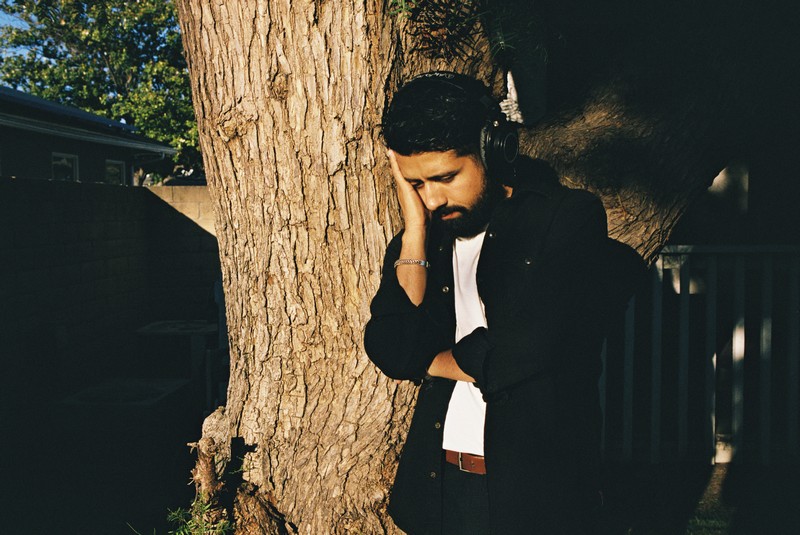
By: Quinn Que
Q) Growing up in East LA and Boyle Heights, how did your multicultural upbringing shape your identity as an artist?
A) It exposed me to a wide range of culture and community. It gave me pride in being from East LA. I saw people working hard, people struggling, people celebrating. That made me want to write songs that felt real and human, because I grew up around voices that weren’t always represented in mainstream music.
Q) What drew you to music initially, and how did you develop your distinctive vocal style?
A) The feeling that music brings is what made me want to dive into creating it – whether it was a chord change, a melody or a certain lyric. It just scratches an itch in my brain. As for my vocal style, I try not to box myself into one sound. I do what the song needs, whether I sing in falsetto or my regular chest voice. That’s the beauty of creating – you can do whatever you want!
Q) Tell us about your journey from writing songs in your bedroom to performing at major festivals like ACL and Tropicalia.
A) It definitely feels like a dream. I started Katzù Oso as an alter ego, someone I could talk to about problems and relationships through songs. I never imagined it would lead to festivals with thousands of people. I was playing house shows and performing at local coffee shops when my music started to pick up on SoundCloud and Spotify. That led to Spotify labeling my music as “Bedroom Pop,” which actually helped get my music out there and opened a lot of doors. I’m forever grateful to the fans who carried those early songs into the world.
Q) The luchador mask became part of your visual identity – what inspired this choice and how does it connect to your Chicano cultura?
A) I love concept albums and making projects feel whole. For Tmí, I wanted the songs to feel like they were being told by a masked luchador – except he was a musician fighting for the broken-hearted and those in love. Lucha Libre was always on TV growing up, especially after the novelas were done, so it felt natural to embody a musician luchador.
Q) “A Woman Like You” marks your first song written entirely in falsetto – what made you want to explore this vocal approach?
A) That was tough to do! I wanted to get out of my comfort zone and try something different. I’ve always been a huge fan of the Bee Gees, and at the time I was listening to a lot of soul music, so I challenged myself to dive into that world.
Q) You mentioned sleeping on the studio floor until the song was complete. What was driving that determination to finish it that night?
A) I started writing it on my Fender Rhodes, and as soon as the main melody came to me I locked in. The rest came so quickly that I didn’t want to kill the momentum. When ideas hit, it’s like a bolt of lightning—you have to take advantage of it. I called up my bandmate Gil to hurry to the studio so we could finish it that night. Sleeping on a hardwood floor is not the most comfortable. [laughs]
Q) How did listening to Durand Jones & The Indications, Herbie Hancock, and Marvin Gaye influence the creation of this track?
A) In so many ways! You can hear it in the record. I’ve always been a fan of Durand and Aaron Frazer – their use of falsetto is so clean. Herbie uses a vocoder in a few of his songs and if you listen closely you can hear a vocoder tucked underneath my vocal in the outro part of “A Woman Like You.” I wanted to capture a sensual feeling/sound especially with the lyrics and Marvin was a huge inspiration for that.
Q) The song deals with vulnerability and reassurance in relationships. Was this inspired by personal experience?
A) It was. Relationships can be scary at times, even after years of being together. That fear of not being good enough or getting replaced is the worst. We all can use a bit of reassurance.
Q) What is your songwriting process for tracks like “A Woman Like You?” Is it the same for every single?
A) It’s always different. For most of this upcoming album, a lot of the songs began on my acoustic guitar or Rhodes, as opposed to my first EP where I started everything with drums and layered over the beat. I still make music that way, but I prefer to write songs on guitar and then build on that.
Q) Tell us about The Paramount show you’re doing in Los Angeles. What can fans expect from this performance?
A) I’m so excited! I’ll be showcasing a lot of the new songs off my upcoming record with a full band.
Q) You’re currently working on your second album. How will it differ from Tmí and what themes are you exploring?
A) I went through a lot of changes in my life between Tmí and now. I lost some friends, I moved out of LA for a year, I gave up a lot of bad habits, and I began to appreciate life and the people in mine more. I was close to giving up on music and myself. I approached this new album with a different mindset – a more confident one. I wanted to prove to myself that I could make a body of work without caring what others thought.
Q) Which artists continue to inspire your sound, and are there any dream collaborations on your wish list?
A) Hmmm…There are so many! Artists like Paul Simon, Tobias Jesso Jr, Julieta Venegas, Dijon, Zoe, Roberto Carlos, Barna Howard – so many older and newer artists keep me inspired. A dream collab for me would have to be Julieta Venegas or Kevin Parker of Tame Impala.
Q) What would you like to say to your fans and supporters?
A) Thank you for your patience while I took time to live and create with no one watching. I’m back now with music I’m proud of, and I can’t wait to share it with you.