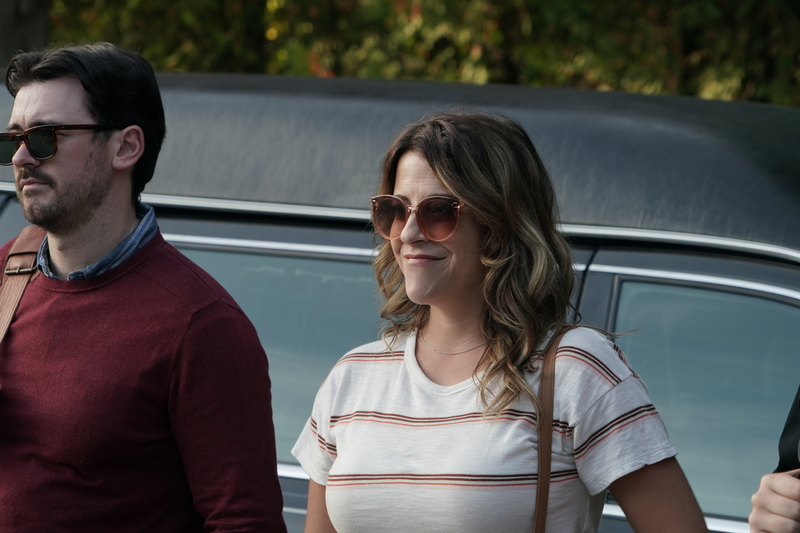
By: Jamie Steinberg
Q) Paula, I’m interested in finding out what was it about Paige or even maybe the show’s premise that drew you to be a part of this series?
Paula: I so loved working with Ian [Carpenter] and Aaron [Martin] on the “Slasher” series, and they always write such incredible characters for me, and for the entire team. I love being part of a world where the female characters are very voicy on the page, and they’re not tropey in any way, as can sometimes be the case in genre. So, for me, it was a very easy yes, Aaron and Ian and I have worked together since “Being Erica,” and he and Ian always surprised me. They write stuff that’s incredibly dark and very funny. And then, when I heard some of my old castmates like Jim Watson here, we’re going to be a part of it – that also makes the yes extra easy and special. So, yeah, it was a lot of fun to come back with a lot of our old “Slasher” family to do “Hell Motel.” A lot of that amazing crew that we’ve worked with so much. It felt like a bit of a summer camp.
Q) Obviously, you enjoyed it, Paula, and it was a lot of fun. But what did you two find difficult about this?
Jim: For me, the interesting thing about the Andy character is that he’s approaching all of this as this sort of analytical skeptic. He’s a PHD. He’s really going in there, and it’s that balance of anyone in that world, in that field. Any skeptic there has to be a kernel of love or appreciation for the thing that they’re actually trying to disprove. And so there was this sort of element of battling the excitement of the moment with each of the scenes that Andy’s in, while also kind of remaining grounded and being ready to point out the obvious to everyone. So, it was just this fun tightrope to walk, and I got to really work closely with our director Adam [MacDonald]. He and I were in constant conversation about, “Is this too much? Is this not enough?” That kind of thing. And it was great because it’s so rare that we actually get to really stretch those kinds of muscles. And Ian and Aaron, they set this stuff up for us like Paula said. They give it to each and every character there’s so much in there to work with. So, it was a lot of fun.
Paula: It’s very juicy material. And you know, as Jim was saying about Andy, and I think this is the case for all the characters. There’s a lot of textures, a lot of layers. We’re also shooting all of it out of order. We shoot all eight at once. So, that’s a unique situation. You’re pre-prepping all eight episodes, the cast and the crew are doing that. So, you’re shooting like a very long movie. So, I’d say the most challenging part is the endurance. We’ve done that model for “Slasher” as well. So, there’s sort of like some you kind of have to be a bit masochistic to love this setup, I think, but I love it because you there’s an adrenaline rush to it, and I think in sort of building in the puzzle. So, I think the challenge is shooting something from a later episode, perhaps at the beginning of the shoot, and then filling in that blank on day fifty of the shoot and making it work with decisions you made creatively at the beginning. I think that’s really fun and part of what’s very joyful about working with actors you love like Jim and this amazing cast. And Adam and Ian and Aaron we’re all kind of watching out for each other and vibing together. So, I think part of the challenge is part of what the joy of it is and then it’s also a physical show. There’s a lot of stunts. There’s a lot of screaming and yelling, and emotional stuff the characters go through. So, I think that’s like part of the challenge. But part of the joy. It’s a very cathartic shoot. I would highly recommend working through whatever you have going on, my friends just out.
Q) Paige is trying to rekindle a career that’s left her behind. Did you see her as a cautionary tale or a redemption story, or maybe a little bit of both?
Paula: When Aaron and Ian and I spoke about this very early, they pitched me her whole arc now it would have been two years ago, and they talked to me about what it might feel like. And I would say of anything we’ve done, it’s the closest. They were like, “What if?” And Adam was like, “What if you just use your voice? What if it’s you know it’s definitely met.” I was like, “Mama’s got to book a little botox for when we wrap because she’s aging out of every part.” I think what was fun is also playing to that very uncomfortable line of like, the thing that does happen when you’ve been growing up in an industry. I just turned thirty-six, very proud to say it, and I started working professionally at eight years old. I’m a veteran in some ways. I’m ready to retire in about ten years and I feel like there’s a part of me that’s seen what is available to women as we age. The things that have been said about like my face and my body to my face and online are shocking, but you become kind of numb to it. So I was interested in playing somebody who we’re sort of meeting her at the very end of that road. She’s kind of like, “Can I even continue in this industry?” And I also really like the idea of Paige being somebody who had to make it on her own financially and didn’t have others’ support. It’s sort of from a middle to lower class situation. She references her family kicking her out. Anybody who’s under the gun, anybody where the stakes are that high – there’s not much you wouldn’t do, and I think that’s a really exciting place to meet a character. So, though she’s very sympathetic, we are set up with somebody who can make all kinds of choices within that. So, I don’t know. I have a lot of empathy for her. I think there’s a redemption story. I think there’s an underdog story. I think there’s a bit of like fuck around and find out with her, like, let’s just see we can curse on here right? I’m thirty-six.
Q) And Jim, with Andy comes the academic world of true crime studies. How did you prepare to portray someone immersed in that kind of analytical thinking, amid literal chaos?
Jim: I mean, any analytical thinking is a big actor stretch for me. So, that was the start. It was kind of, you know. I’m not gonna lie. Ian and Aaron and Adam the team – they really set it up like on a T-ball for me. They gave me all the information. Ian especially was so good at really telling me to, “If you’re going to go here, focus on this sort of pathway, look into this sort of Satanic ritualisms,” and things like that. But, actually, the the thing I was most concerned about was portraying that intellectual, that PHD sort of personality, and a friend of mine’s son is currently going through the process, and he and I sat down, and we had a really good chat about like what is what is it to defend your PHD. What should I expect in that room? And so it was sadly a stretch for me to play someone with such a high intellect. But it was fun and I think I pulled it off. We’re gonna have to wait and see. But, yeah, I did. Well, I did well, and to be honest, with the cast of characters we had what I found mostly was you really found your place. Everyone sort of slotted into this puzzle that was created by the creatives, and it really just felt like stepping into a nice pair of shoes, and just going on a nice walk with everyone and so many familiar faces it was strangely not that difficult. I don’t know how you know. It just felt right. It felt really, really nice.
Q) A lot of us love horror television shows. However, it’s not the easiest thing to film because there’s lots of blood and kills, especially on these kinds of shows. So, how do you take care of yourself as an actor when you’re filming because, yes, it’s fun but also it’s a lot.
Jim: It’s one of those… I mean, I stretched. There was a lot of physical preparation for most of the days. But, honestly, blood isn’t my thing – like it does kind of freak me out a bit. And we had an amazing props person who allowed us to sort of really ask questions (Daryl – love them) and that really allowed me to get close to like the instruments and things like that. We’d be standing around or if we were ever in those situations. It was really reminding myself that this is all pretend, like, you know, that was the that was the best approach I could do for a lot of these scenes, because some of the sets were horrifying, like just absolutely like if I suddenly passed out and, like my buddies, dragged me into this room and I woke up. I don’t know that would have been immediate cardiac arrest. Get me out of there! So, just really reminding myself that everything’s okay. And I’d hold on to Paula tightly once in a while.
Paula: That I would, and a dance break now and again. Jim and I do this little dance break that was.
Jim: It was beautiful. It was.
Paula: That’s how that’s mental health to me. That’s how I would take care of myself and Jim. I think a great craft table. I think we’d have grilled cheese at the right moment. Charcuterie, knowing when to snack up. And like truly like laughing within it because you are simulating, like crying and heavy breathing, and some of the stuff I should have stretched a bit more. Let’s start there, to your first point. And I’m a singer, just being aware of, like the vocal strain so truly just physically stretching my voice, I would do a lot. I would warm up a lot in the morning. I’d cool down at the end of the night. As we got to the end of the shoot I was using different techniques just kind of like taking care of that because the voice does tell a lot of the story for this show for sure to say the least.
Q) I have to ask you both about filming with Eric Mccormick, because he’s such a comedic talent. But you’re in this serious seance situation where he serves you…I don’t know what those heads were made of to be honest.
Jim: For me, I mean that was my first time working with him, and like I mean, he’s probably heard this a million times – I grew up watching “Will and Grace” – like I loved him. He was this outlet in a small town community of this other thing, and I just – I worship that individual. So, getting to work with him and meet with him, my expectations were like pretty high, and he just came in and was the most humble, sweetest, nicest person. And yeah, funny. Like duh, he’s funny, but like actually just a funny person doing silly things, too, with just the stuff that you’re like, “Oh, my dad would do that!” But then you’re like when he does it, it’s hilarious. He was just wonderful. He was just a shining star in a very dark and murderous environment.
Paula: Yes, I feel the same. I worked with Eric last season of “Slasher” that we did, and I was a bit nervous to meet him because I, too, was such a huge “Will and Grace” fan. I was worried I would call him “Will” on set, frankly and just like that show meant so much to me and my mom growing up, and he is everything you’d want him to be and more. He is such a delight! He’s such a Toronto boy. We went to see our friend up in Stratford last year. Our Buddy, Dan Shamroy, is one of the stars of Stratford and like going to Swish Chalet together and talking about Toronto hotspots. Yeah, he’s one of us. He’s one of us, and he loves being part of our motley crew on “Slasher.” I feel like we’re doing this like gritty indie, and he’s so down for that, and so playful as an actor. And we can’t say enough good things about him and shout out to our team.
Q) Jim, I know that Paula said her character was a lot like her, and you talked about how he was different from you. But what part of you do you feel like of yourself that you sort of brought to him?
Jim: Oh, I think a big one is the skeptic. I think that sort of is a thing. I like to question things, and I never take things at face value. I tend to say, “Okay, cool. Give me your information. Let’s circle back in a day after everyone’s calmed down.” That’s sort of how I approach most things. And so that was nice. So, that level of Andy was very true to me. There’s a patience to it, which is really interesting in a horror setting when time is really of the essence and you have to. It’s fight or flight, and I don’t have the time to go, “Well, let’s just talk this out.” There’s none of that. So, that was exciting to kind of live in my own special place, which really I don’t get to play a lot to be honest with you, but then to have to be jerked out of that at a moment’s notice was an enjoyable experience for an actor.
Q) There’s a fun legacy to fill for both of your characters. You know the scream queen and the true crime! Did you guys draw from any real life, personas or media to help shape these characters?
Jim: I mean, for me, like my wife and I, we love to listen to those podcasts that tell you about every horrific murder. So, that sort of that sort of approach that that just that storytelling, too, of true crime dramas. It’s really an interesting thing to retell a story that is very familiar to people in a new and enticing way, and in some respect that is what the creators of “Hell Motel” and “Slasher” and you know they’re really playing into a genre that’s well established, and they’re paying homage. So, that was very helpful for me to kind of find the rhythms of the approach to the work and the retelling of an old story. In a sense. So, yeah, we listen to a lot of murder podcasts.
Paula: Yeah, I’ve gotten into those two, Jim. Those are oddly like comforting. And they’re crazy.
Jim: Yeah, which is very scary that we’re comfortable.
Paula: Well, I guess I’ve read this somewhere. But women, I think women love them too, and Jim told me, if this feels right for your lady. But it’s like we like knowing we were right. We’re right to be as worried as we are. I just want to feel validated.
Jim: It’s true. Yes, I get a lot of side eyes from my wife going, “See?”
Paula: Honestly, I think, for Paige adam and I talked a lot about Jennifer Love Hewitt. I Know what You Did Last Summer was like iconic, and she’s just amazing in that. And I think like Neve Campbell I thought a lot about. I think that’s who Paige would have wanted to be in the height of her career, in her heyday. I think she was on her way. Maybe there. I love Drew Barrymore so much in Scream. I love the Scream franchise. I do scare very easily. But those kind of OG films I. loved, and I think we talked about that in terms of like how she dressed, how her makeup shifted even slightly. I made some conscious choices early that I don’t think she like laughs and smiles very much. She’s not super light, and that’s not how she’s leading, and hasn’t led with that for a long time. So, yeah, I kind of wanted to see her feeling a bit dimmer than maybe those people that like she would have wanted to emulate.
Q) I love to hear that! That’s wild to actually know that some thought went into that because you guys both have quite the catalogs of projects that you’ve worked on. Not just horror, obviously. But do those kinds of change how you feel about true crime, culture or even horror fandom? Because it is a different animal, and the more you dig it’s almost kind of like a family in a way.
Paula: I love the fan base. I think it’s so voracious and loyal, and I love the winking at the genre. I love the humor within the Slasher genre. I love the homage that’s paid. I really love it on a filmmaking level, like from the lighting to the sound design, the score. Everyone’s amazing. But I think there’s such an artistry to it that I’ve really really appreciated. And just like how you’re framing a shot. How different that would be if it wasn’t genre. Yeah, I really like just the homage that’s paid from project to project. I think there’s such an appreciation for each other’s work, and I think that’s really really special. And I felt a lot of warmth from the horror community since starting “Slasher.”
Jim: Honestly, I was going to say the fan base is so good also at pointing out those pieces of homage that are being paid. You could do something as simple as a classic camera trick and there are fans that are like, “Oh, that was from that movie from eighteen…Not the eighteen hundreds. [laughs] But you know what I mean. Like they are very passionate group, and it makes filming these things that much more special, because someone’s gonna get it.
Q) One of the things I really appreciate about “Slasher” and this new show that you all are doing is that the characters are always very fun and complex. They’re never just one note. And so everyone’s a viable suspect. Do you have fun playing in those areas, even when it is not your turn to be the murderer or the victim? How do you do this?
Jim: I’m still trying to figure it out. I don’t even know. They keep paying me, though. So, there is something. Yeah, there is something really enjoyable about it. And, again, you might not even…Like I’ve seen things on playback, or I’ve seen things in trailer cuts where I’m like “Whoa”! Like they just have a way of framing you in such a beautiful way that they can build suspense. They can build the questioning. And because the truth is anytime you’ll play into something as an actor. It comes off really, Phony, so a lot of it is a bit of a not worrying about that, showing up, doing your job, playing the scene and letting the crew the DP – the lighting and the directing – like it really can shape those moments in a way that no actor could on the planet. You require your team around you to to really help, emphasize beats and sometimes the less we know the better like in the end.
Paula: No, you’re right. Sometimes like if we didn’t have all the scripts upfront and we weren’t shooting out of order I know we probably still need to know some things part of me wonders. There’d be a joy, though, in not knowing as much as we do up front. But I think also like I love what Jim just said because it is about trusting the whole team. And I think in terms of this genre the thing that I found so freeing is freeing yourself of the pressure to think the performance ends with you on the day because so much is added later, like, in the edit in general, with TV and film. I think the joy of it is knowing that your performance also is shaped in the edit. So, you want to be able to give as many options as possible and trust this. Trust that your showrunner, director and editors are going to pick what they feel is right to shape the performance, to work for the story. So, I find that takes some of the pressure off, to be honest, and has allowed me to, after many seasons on “Slasher” just have a little more fun playing and seeing what comes, and maybe trying different things. And you know whether it’s killer or victim, it is really fun to play because the stakes are really high. I think that’s the part that’s also really joyful about this kind of genre. It’s almost like operatic – something Ian said once that I thought was very cool.
Press Roundtable
Hell Motel debuted with a two-episode premiere on Tuesday, June 17th on Shudder and AMC+; New episodes release weekly on Tuesdays.