By: Kelly Kearney
Q) You wrote, directed, and starred in the short film Bad Survivor, which premiered in L.A. at their year’s Slamdance Film Festival. It’s a true story about a woman–yourself, who’s on the other side of cancer treatment trying to figure out how to live after living so long with death. The title feels defiant. How did you land on it, and what does it represent to you?
A) The title Bad Survivor came from a phrase I secretly called myself in early remission. At the time, I would watch survivors speaking so eloquently about their experiences, in public no less. I would see them raising thousands of dollars for cancer research, wearing cancer ribbon t-shirts with pride and advocating for themselves. I saw them as these beacons of hope, totally able to play the part of the inspirational survivor. Meanwhile, I was begging to be let back into my hospital, asking to be scanned every day and clinging onto my radiation mask like a safety blanket. I was struggling to fit back into the real world. I was a bad survivor. And at the time, I thought I was the only one.
Q) How long did it take you to bring this short to life from script to final edit?
A) About a year and a half in total.
Q) The tone is darkly funny and wrestles with the uncomfortable truth about mortality–especially when it comes to everyone but the patient. You survived Hodgkin’s Lymphoma so it would have been easy to lean into the traumas you experienced. Why did you choose comedy as the lens to explore something as heavy as cancer?
A) When I speak with other young cancer survivors, there’s one thing we all have in common – a dark sense of humor. It’s how we cope, how we survive and how we re-enter the world of the living. So, in telling a story of remission, the humor was easy to find. I couldn’t imagine a different genre for this story.
Q) Topics like this are such a delicate balance — too much humor and you lose the weight; too much pain and you lose the laugh. How did you find that balance in your performance?
A) That felt like such an important balance to find in the script. And once it came time to perform, I worked with my acting coach to drop back into the feeling of early remission, using visualization tools. I wanted the weight of what this character was in the midst of to be ever present. Because if I could hold the darkness of her reality, then I knew the layer of humor on top wouldn’t be making light of her diagnosis but rather would show that it’s her only way of existing. My goal was to allow the humor to draw audiences in by creating a level playing field.
Q) Were there any moments in the film that felt “too real” or difficult to revisit?
A) Luckily, no. Filming felt truly cathartic. I was reenacting the most traumatic time in my life, only this time my character got to say all the sassy, naughty, inappropriate lines I never would have the guts to in real life. But, in our “Bad Survivor” television series (here I’ll have more time to explore our main character’s world), there will certainly be story lines that will feel too real to revisit. But I’m choosing to anyway. Thank God for therapy.
Q) The film also touches on the loneliness that often comes with illness — that feeling of people meaning well while keeping you at a distance. How did you want to capture that in your storytelling, because Alex definitely chooses to add to everyone’s discomfort, like she gets a kick out of poking at their fears?
A) The first half of the film has loads of dialogue, quick quips being jabbed around the dinner table – Alex antagonizing her sister (Katie North) and having solo inner monologues to camera where she gets to react to everyone’s projections of her. And the second half is silent – Alex closing the door to her bedroom and being alone for the first time since being diagnosed. That loneliness is so crucial to explore because when your very presence reminds others of death, it’s a burden that’s difficult to carry in public. And while being alone may be a momentary reprieve from that burden, that’s when you, yourself, as the cancer patient/survivor have to look in the mirror and figure out how you feel about you now. Now that everything has changed.
Q) As if living it and then writing, directing and acting in this wasn’t personal enough, you also cast family. We meet your father— cursing in Czech and trying to keep the peace. What was it like directing him and how much of that dynamic mirrors your real relationship?
A) My parents and my sister were such good sports! I mean, imagine your daughter saying, “Hey, let’s recreate the most traumatic time in our family’s life and film it. But this time it’s funny, I swear.” They must really trust me.
My dad is from Prague and my mom from Puerto Rico and I wanted to bring to life their culture, languages and banter to screen. And it felt important to show that Alex, the character, is a first-generation mainland American girl. My family by far gets the biggest laughs at screenings, and it’s so gratifying to see.
Q) Indie shorts mean quick shooting schedules. Were you faced with any production challenges, especially while juggling directing and starring?
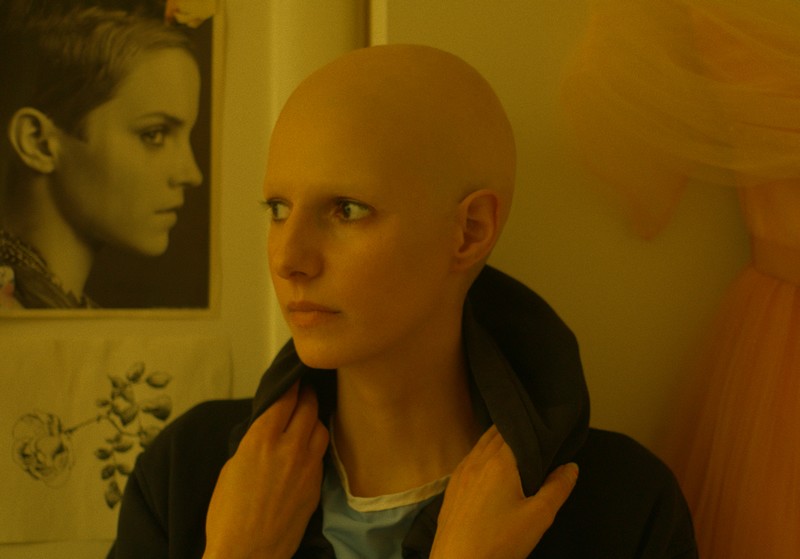
A) Absolutely! One of the biggest logistical challenges was my bald cap application before each day of filming. I needed to be in hair and makeup for four hours each morning, which means I couldn’t be running around set putting out fires, making sure everyone was ready and had what they needed. Thankfully, I had my co-producer Katie North who is a gem on set. She really knows how to work so efficiently while somehow raising everyone’s excitement for the project. My biggest task by far was to be as prepped beforehand has possible, so that the second I was off the hair and makeup chair, I could hit the ground running as a leader on set.
Q) There aren’t many films that allow us to laugh in cancer’s face. Do you see Bad Survivor expanding into a feature-length project or possible TV series someday?
A) “Bad Survivor” the TV series is in development!! I’m flipping the script on the cancer story we’re used to seeing. We’re building out an amazing team for the series, who have the same vision and mission I do.
Q) Have audiences reacted in ways you didn’t expect — either laughing at unexpected moments or feeling deeply moved where you thought they’d laugh?
A) I love to sit in the very back row of every screening, just to get a sense of where audiences are connecting with the material. Across the board, people seem to tense up the first time they see bald Alex. She speaks to camera for the first time and people seem unsure if they’re allowed to laugh. But by the second or third jab, audiences seem to say to themselves, “Okay, if she’s laughing at herself then we can too.” To me, that’s the gold. That’s where dark humor can cut through taboos or otherwise sensitive and untouched topics.
Q) The short invites us to laugh in cancer’s face, which is something we rarely see in film. What do you hope viewers take away from that choice?
A) I hope viewers see themselves in Alex. I hope this film and our TV series starts conversations amongst families to better understand the point of view of a survivor or patient. Ultimately, I hope it helps other bad survivors feel seen and understood.
Q) What’s next for you, Alex? Are there other projects in the works?
A) My original YA graphic novel, of which Bad Survivor is based on, will be announced very soon! And, of course, stay tuned for “Bad Survivor” the TV series.