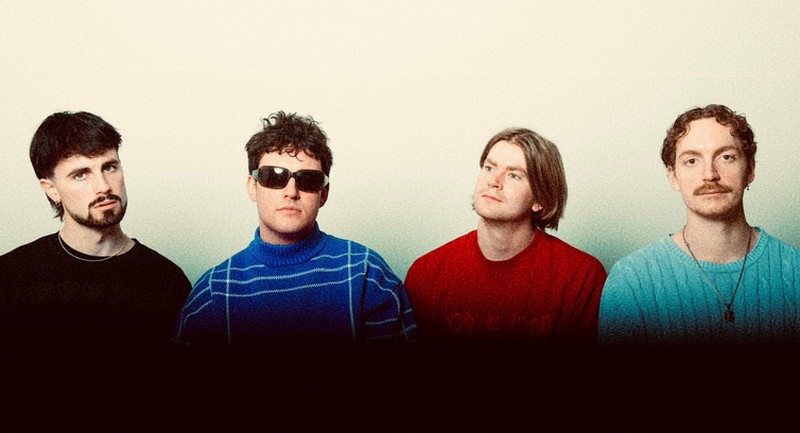
By: Kelly Kearney
Photo By Patricia Rosingana
Q) Looking back at the Basht. journey, what were some of your biggest influences when you were first developing your sound?
A) I would say there is quite a mix of influences between us as a band. Definitely some big ones would be songwriters like Lou Reed, Bob Dylan or bands like the Pixies, The Stone Roses, Radiohead, etc. We all listen to all sorts though, really!
Q) Your new album, Poor Advice, tackles everything from church and state in Ireland to modern corporate capitalism. How did you settle on a title that tied all of those heavy themes together?
A) I think “poor advice” felt like a phrase that could sit across a lot of the ideas on the record without being too specific. A lot of the songs are looking at systems, institutions and the ways they can influence people’s lives, but also at the choices we make within those systems. There’s a sense of people being given advice or guidance that might not necessarily serve them, whether that comes from institutions, society or even from ourselves.
Q) After building momentum through standalone singles and EPs, what was the biggest challenge in creating a cohesive 10-track album?
A) I think the biggest pressure around this album was time to be honest. We had a mental tour schedule and a good portion of the album was written on the road, between shows, in sound checks or sometimes there and then in the studio. It definitely captures a moment in time for us as a group!
Q) Compared to the other singles, “Terror TV” feels like a bit of a step in a different direction. How does that track fit into the broader sound of the album?
A) Yeah, I think “Terror TV” definitely has its own identity, but it still feels like an important part of the album as a whole. We wanted the record to have some contrast and different textures, rather than every song sitting in exactly the same place. It brings a slightly different energy and perspective, but there are still elements of it that tie back into the wider sound of the record.
Q) Another standout track of yours, “Keira Knightley,” flips that iconic Love Actually doorstep scene on its head into something much darker about desperation and jealousy. What inspired you to use that famous romantic movie moment as a window into a toxic relationship?
A) I think that scene is such an interesting example of how something can be presented as romantic on screen, while looking quite different when you take a step back and think about what’s happening. We wanted to play with that idea and turn the scene into something more uncomfortable, exploring the desperation, jealousy and obsession that can sit underneath those kinds of relationships.
Q) You recorded this new album with producer Ali Chant, who has worked with artists like Dry Cleaning and the iconic songstress PJ Harvey. What did he bring to the process, particularly when it came to translating these heavier concepts into sound?
A) Yeah, we all really loved working with Ali. He has an incredible attention to detail and he was great at getting right into the finer points of the songs and helping us really scrutinize certain sections. He brought lots of thoughtful suggestions and ideas to the process without ever losing sight of what we were trying to achieve. I think he really understood the weight and atmosphere we were trying to create and it was a real joy to work alongside him.
Q) Was there a particular song on the record that was tricky to pull together–especially when testing it out live? I am thinking about “Kids Vs. Guns?”
A) “Kids Vs Guns” definitely went through a few different iterations. The original idea is nearly unrecognizable from where we finally landed in the end. But when it came to playing live once we had settled on a final arrangement it all seemed to fall into place. There are a couple of Melotron/synth parts that we don’t always play as a 4-piece, but all in all that one feels great live. There are a couple of tracks, like “Superchurch” for example, where we’ve had to incorporate some sampling / SPD triggers to pull off live and we also have a great friend, Louis Younge, who joins us for bigger shows to play some extra parts from the new record.
Q) When it comes to performing, you’ve spent a lot of time on the road touring with bands like Wunderhorse, DEADLETTER and Everything Everything. How did testing these songs live in front of those audiences before finishing the album shape their final studio versions?
A) Yeah, it was certainly a huge part of the process, and a real privilege to be able to test new music live while we were still creating it. It helped shape some of the creative decisions we made and gave us the opportunity to see, in real time, what was working and what could be improved. There’s something really valuable about getting that immediate reaction and then being able to take that back into the studio.
Q) Is there a track on this new album that seems to be a fan favorite? Maybe one you weren’t expecting but the audience’s reaction surprised you?
A) Well, it remains to be seen once the album is fully released, but we have been receiving a lot of love on the latest single “Kids Vs Guns.” This is a track we hold close to our hearts and we’re happy to see a warm response to its release
Q) Now that the record is complete, you’re heading back out on tour. What are you most excited to bring to the stage with this new material?
A) I think we’re really excited to see how these songs come to life in a live setting. There’s a lot of energy and intensity in the new material, so we’re looking forward to exploring that on stage and seeing how it connects with people. We’ve also had some time to figure out how the new songs sit alongside the older material, so it’ll be exciting to bring the whole thing together as a set.
Q) When listeners reach the end of Poor Advice, what do you hope stays with them?
A) I think more than anything, we hope it leaves them with something to sit with. There are definitely some heavier ideas running through the record, but we’ve always wanted the music to feel open to interpretation and for people to take their own meaning from it. If someone reaches the end and feels something, whether that’s challenged, moved, energized or even just curious, then that’s a great thing.
Q) What would you like to say to everyone who are fans and supporters of you and the music that you make?
A) Honestly, just thank you. We’re incredibly grateful to everyone who has listened to the music, come to shows, shared it with friends or supported us in any way. It means a huge amount to know that the songs connect with people and have found a place in their lives.
All Questions Answered By Lughaidh Armstrong