By: Kemberlie Spivey
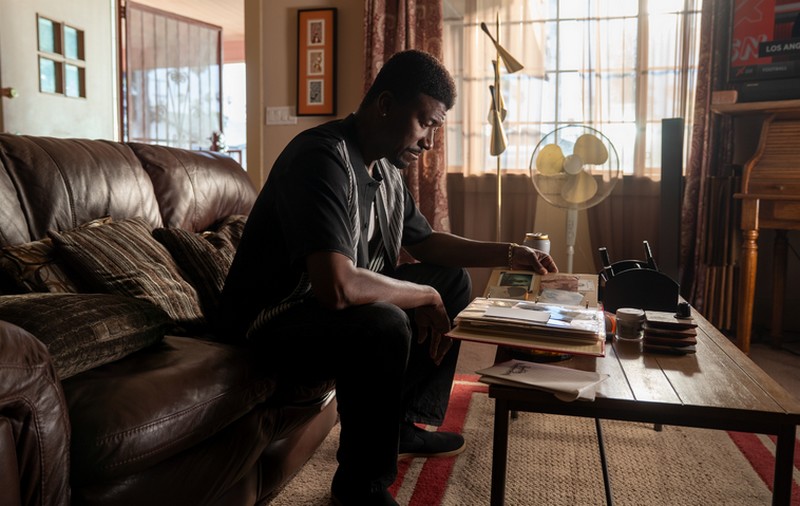
Photo By Saeed Adyani/Netflix © 2026
Q) Amos “Nightmare” Stiles is a man with a huge reputation in the streets but a painful legacy at home. What drew you to a character who lives in that kind of contradiction?
A) Honestly, I think It’s more that it found me rather than me finding it. I believe roles find you in a weird sort of way. When you see brilliant performances where you literally cannot picture anyone else, those are ordained for that person in my opinion. I had originally auditioned to play the police chief, now played by the brilliant Michael Potts. I sent in the tape and didn’t hear anything and a few weeks later they sent the audition for Amos which was a 180 degree turn from the chief. That said, I can certainly relate to Amos from a core level. Amos is prone to self-sabotage – I’ve been there. Amos has made bad parenting decisions – so have I. Not to his degree but still. We’re all trying to get through this thing called life and do better. Amos is no exception.
Q) The relationship between Amos and Isaiah is deeply strained, especially because of the past and the loss Isaiah can never fully move past. How did you approach playing that father-son tension?
A) My dad was the most reliable person I’ve ever met. Never, in my entire life, did he tell me he was going to do something and didn’t do it. Not. Once. But I was this artsy kid with his head in the clouds and he couldn’t understand it so we butt heads. And that’s just what it was. He taught me an insane work ethic, but there was tension along the way. In retrospect it was very simple, That’s how he showed his love. But I was a wild dude so I didn’t see it that way. So, I used my own life experience to deepen the approach to Amos and Isaiah.
Q) Amos and Isaiah are both intense, stubborn, and shaped by survival, even though they chose very different paths. In your view, what makes them so much alike, and what makes them unable to fully connect?
A) It’s such a cliche but we really do become our parents, especially when parenting. I have three kids and my ex-wife would always say, “You sound just like your dad.” I’m much more like him than I ever imagined I would or could be. Even saying it now makes me laugh. But there it is. That stuff sinks in whether you want it to or not. I think Isaiah (Matthew Law) can’t square with that fact. And Amos sees it but doesn’t have the tools to fix it or communicate properly about it. The result is this never ending standoff.
Q) Noah represents a new generation observing Amos without the same history of resentment as Isaiah. How does Amos behave differently around Noah compared to his son?
A) Noah (Cedric Joe) is the golden child for Amos. He represents salvation. And because he’s older now with a lil less testosterone, he has the capacity to show love to Noah in a way that he couldn’t for Isaiah. This is Amos’ final chance to get parenting right. And he needs it. We all want to get it right. I’m certainly a more relaxed father with my youngest than with my first two. And that’s as it should be. I root for Amos in that.
Q) Noah witnessing Amos’ murder is a devastating turning point. Even though Amos is gone, how do you think that moment reshapes the entire family legacy moving forward?
A) That’s the million dollar question. That kind of trauma has the potential to derail any family. It becomes the family story – secrets are revealed, resentments creep in, truths that were left unsaid. To some he’ll be a hero. Others will think “good riddance.” I think the family legacy depends on how much of Amos’ DNA starts to take over for Isaiah and whether or not he can control Noah from becoming “little Nightmare.”
Q) Amos makes some ruthless decisions throughout the story, including turning on members of his own crew. As an actor, how do you balance portraying someone dangerous while still making audiences understand the humanity behind him?
A) That is the best part of this work – the dimensions. I was taught to bring the character to you. Use your life experience to empathize and not judge the character. I believe if you can do this then you can find the truth of the given circumstance. Not playing an idea or cliche. And if you feel it, the audience will feel the turns of emotion. I recently saw Jonathan Majors in Magazine Dreams. An absolutely brilliant performance in this regard. He was dialed in such a deep, dark manner with no judgement. And so, if we’re living a slice of life and not acting it makes a big difference.
Q) Your character ultimately becomes entangled with Coltrane Wilder, who later kills him—how did you build that relationship so the betrayal and tension felt earned?
A) I think that starts off camera. Y’lan [Noel] is fantastic and we both have a lot of respect for each other’s work and became friends as all of us did. And my hope is that that shines through so that you felt that Amos and Coltrane had history.
Q) Amos and Wilder also share a history that includes time in jail together—what kind of unspoken understanding exists between them before everything falls apart?
A) That’s two fold. First, they experienced jail and jail as black men, which is its own thing. So, I think the two characters have respect for each other for making it out of that alive. The problem is being back out on the streets doesn’t necessarily equate to loyalty.
Q) How did your experience working with the cast help shape the emotional weight of Amos’ relationships, especially in family-centered scenes with Isaiah and Noah?
A) There’s a shared comradery between actors and people in this business that we survive this business and keep going. It’s kinda like soldiers surviving war. So, everyone respected the legacy of talent from Mario Van Peebles to William Allen Smith to Dawnn Lewis and Michael Potts. Different generations of talent there and so we all had some great conversations off camera. It was wonderful. And that is what we see at the table – a character family of different generations of actors doing this work in a way that felt natural because we all genuinely care for and respect each other.
Q) Even though Amos dies, his presence still feels like it leaves a huge impact on Isaiah’s life moving forward. What do you think Amos would have wanted Isaiah to learn from all of his mistakes?
A) I think Amos would have wanted Isaiah to slow down and smell the roses and to stop acting out of anger and ego – to enjoy life more and to reconfigure his priorities. Matthew Law has this great way of playing Isaiah where you feel this anger bubbling inside him all the time. That’s trauma. Amos is also his nemesis. I love Amos because he “tries real hard to be the shepherd.” He can’t get out of his own way but goddammit it’s not for lack of trying. I love him for that.
Q) What are the other upcoming projects that you’re excited about that we should keep our eyes on?
A) Currently I’m in pre-production for a feature film based on a short film I wrote and directed years ago which I’ll announce as we get the ball rolling.
Q) What would you like to say to fans and supporters of the wonderful work you continue to do on our screens?
A) It is an absolute joy to hear from people all over the world who have enjoyed the show and Amos – a/k/a Nightmare. I have been overwhelmed with kindness and well wishes and support and love for that character and I cannot express how much gratitude I have for all of these new fans and people I’m hearing from. So, thank you for making “Nemesis” the most watched show across any platform. Thank you truly. Your enthusiasm will create more seasons.