By: Malasha Parker
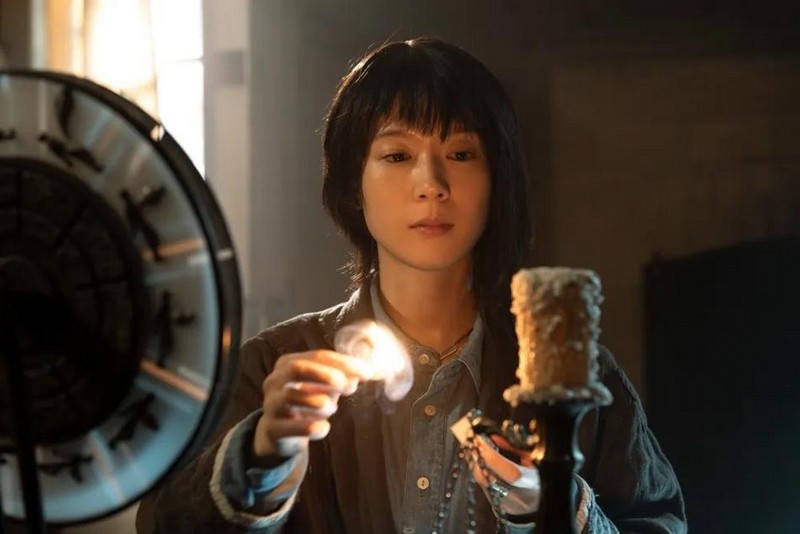
Photo By XYZ Film
Never After Dark has a slow and confusing start, but eventually comes together in an explosive and beautifully heartbreaking way. Moeka Hoshi gives a phenomenal performance as Ariri that elevates the horror film and allows space for audiences to learn her motives. Never After Dark is as much a supernatural thriller as it is a film on coming to terms with grief.
Airi (Hoshi) and her “older” sister visit a home that they have been requested to rid of spirits. Airi comes to the house deep in the woods and instantly becomes suspicious thanks to her sister Gunji (Kento Kaku). She exits the car, but it’s just her and not her sister as well. She meets with Teiko (Tae Kimura) who owns the house and has requested her services. Teiko assesses the house and tells Teiko and Gunji they need to leave so she can work. While she’s alone Airi becomes more relaxed and lounges around the house. She notices some noise and flickering lights. She sees a man (Mutsuo Yoshioka) with a mutilated face in a room. She follows him but he disappears. She begins her rituals and finds some other supernatural being in the house while she is in between worlds. The man she saw earlier begins to chase her and she eventually outruns him to blow out a candle. She goes outside and reenters the house after seeing Teiko in the mirror with her mouth wide open being pulled back. As things unfold, the supernatural being turns out to be something she has never encountered before. It challenges Airi to make decisions and face different parts of her own life that she has been running from. From revealing moments and twists so well executed, Never After Dark ends with Ariri finally facing her darkest fears and ending where she always wanted to be.
Moeka Hoshi, a breakout star of the series “Shōgun,” gives a convincing performance as Airii, the medium. Her character presents as a strong and confident person, but easily starts to show emotion when she’s near her older sister. She experiences a mirage of different personalities that are subtle throughout the film. It is noticeable how her demeanor changes when she is around others versus when she is alone. Airi is a complex character and Hoshi’s performance captures all of her complexities. Mutsuo Yoshioka as the man with the gaping mouth gives viewers something terrifying to watch and plays his role expertly. The character only really speaks in his living form, but he has such a grand presence that he doesn’t have to say much. His physicality as a scary supernatural being is performed perfectly. Kurumi Inagaki as Miku and Tae Kimura as Teiko also bring originality to their characters. Inagaki is still a young actor, but this role shows how powerful her performances are based on her ability to make such an impact as someone audiences can only see through reflections when Airi is thinking of her.
Director Dave Boyle does a fantastic job of utilizing the small amount of space he has for this film. The shooting took place in an unused house in Kiyosato and though the house seems big, the film is mainly shot inside the house. However, Boyle’s use of the variety of rooms and angles broadens the space. The cinematography is ambitious and the CGI and special effects are enhanced so well throughout the film. The eerie moments are when Airi sees “The Gaping Mouth Man” in the room and in flashes. The directing and cinematography is also so well executed with the scenes of Teiko as she is shown in different angled reflections. The production overall is well done. The lighting is especially noteworthy. With so many horror and thriller films, the lighting can easily be too dim for viewers to enjoy the movie. But Boyle’s Never After Dark shows his and Hidenori Nagata’s skills in knowing how to light a scene to show ominous and serious tones in the right way.
Never After Dark is a wild and unexpected ride through supernatural forces and a reflection on grief. Every moment has a point and is purposeful for the ending resolution. From the special effects to the amazing acting, this feature film delivers in every way. One thing about Japanese films is their ability to say so much with silent and soft toned moments is what makes their films so unique to watch in any genre. Never After Dark uses that uniqueness in this horror movie and it does it well.