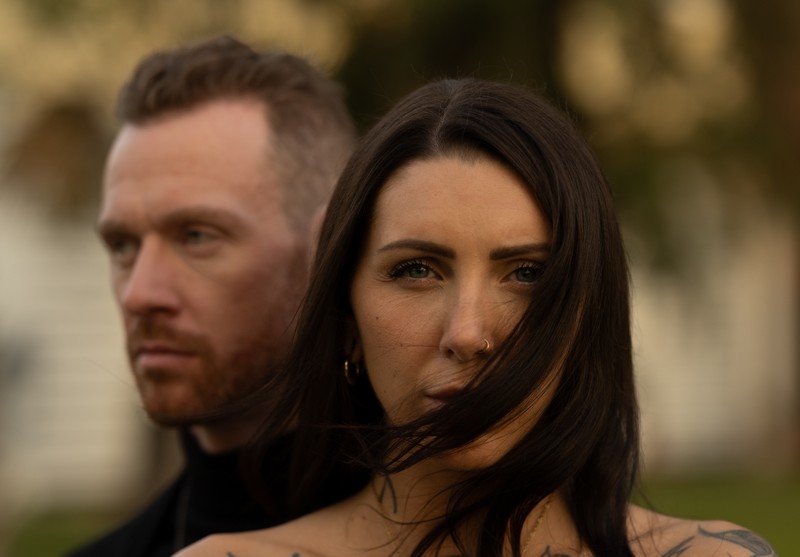
By: Jessica Hatchett
Photo By Hannah Wild
Q) Your music is described as having an ethereal, layered vocal landscape. How did you develop your signature sound?
A) I was born in Kodiak, Alaska, where everything is fog and ocean and I think that texture got into me early. Grey is my favorite color from spending so much time on these coasts and the infinite shades of that color also influence all the layers in our sound. And then growing up in church choir I learned to sing with many overlapping voices.
Q) What musicians or genres have had the biggest influence on you?
A) Early on it was SOHN, James Blake and Emmit Fenn — that vapor-soul world where the voice is treated like an instrument. Over the last few years, I’ve moved toward Ocie Elliott, RY X, Rhye, Novo Amor, Trevor Hall and Ajeet – music that’s still, acoustic and unafraid of tenderness. And a lot of what shapes the songs isn’t music at all — meditation, silence, long walks by water.
Q) Your music has gained attention in countries ranging from Brazil to the Netherlands. What does it mean to you to be so well received in so many other areas of the world?
A) It’s the most reassuring thing about the whole project. When I look at where people are listening — São Paulo, Istanbul, Kyiv, Lagos, Amsterdam, Berlin — these are people I’ll likely never meet, most of whom don’t share my language or my life. If the feeling still lands, then the feeling is the real thing and the words are just its carrier. Sorrow turning into something you can live with is a universal experience. That’s what we’re writing about.
Q) You’ve worked with artists including Emmit Fenn, DTO, El Porto, Mooji, Deep Koliis, Diamonde, and Tate Tucker. How do you combine your artistic identity with another artist’s vision?
A) I try to be the atmosphere rather than the subject. Every one of those artists has a very clear center, so my job is to listen first and then bring the one thing I do — the layered vocal texture — as a color they didn’t have in the room before. If it’s done right, the song still sounds entirely like them, just with more air in it.
Q) Talking of other artists, how did the collaboration between you and Alia first come about and what inspired you both to create Ocean Eyes rather than collaborating on one song?
A) Alia and I first connected as friends over a shared experience of grief. We processed grief in the same way, through song so first one came out — and then another arrived and another. When we finally sat down to write together properly, on a retreat on the Chilean coast, nine songs were needed to tell the complete story of how we were feeling. At that point calling it a collaboration would have been dishonest. It was clearly its own thing with its own name, “Ocean Eyes.”
Q) Ocean Eyes has been compared to artists like Ocie Elliott and RY X. How do you feel about those comparisons?
A) Grateful and a little exposed because those are the two references we’d have chosen ourselves. Ocie Elliott for the chemistry between two voices that actually love each other; RY X for the electronic subtlety, stillness and the patience. If we can hold both of those in one song, we’re doing what we set out to do. Long term, of course, we’d rather be the first Ocean Eyes than the next anyone.
Q) What is your typical songwriting process? Do you need music before you can begin crafting a lyric?
A) Poetry first, almost always. I’ve said before that to write a poem you first have to survive it; the lyric is what’s left after the surviving. And then comes the melody and then everything else.
Q) What was the production process behind “Tides” and are you always so hands-on in that area?
A) “Tides” was written in Chile with the ocean literally in front of us and grief right beside us — that’s not a metaphor, it was the situation. We built the vocal architecture and the arrangement ourselves and then we worked with my long-time producer Shane Hazleton, who rebuilt the instrumentation and gave it the slow pulse underneath the folk — the bass and kick that make it feel like water moving. We went back and forth until it breathed just right. So, yes, always hands-on; the vocals and the shape of a song are the part I can’t hand to anyone.
Q) What emotions or themes do you hope listeners will take away from the song?
A) Permission. Grief doesn’t leave, it comes and goes like a tide and that’s not a failure — it’s the shape of it. If someone hears “Tides” and feels allowed to be exactly where they are for three and a half minutes, that’s the whole point. The healing is in the allowing.
Q) Who are some artists that you would love to collaborate with on music in the future?
A) Ocie Elliott, obviously. RY X and Novo Amor. Rhye. Trevor Hall and Ajeet on the more devotional side. And, of course, Bon Iver — the original inspiration for our Chilean retreat.
Q) Have you already been working on new music or with “Tides” and Ocean Eyes out now could this be a prelude to a full album or EP?
A) “Tides” is the title track of our nine-song debut album and the record is finished. But Alia and I have already received the calling of a new place, Iceland, in a project we already feel will be called “Aurora,” going deeper into the mystery, farther from obvious storytelling, into the liminal space where light dances as the movement of our lives.
Q) What would you like to say to everyone who is a fan and supporter of you and your work?
A) Thank you for letting these songs into the parts of your life they were written for. They were my alchemy — the way I turned the hardest years into something I could carry — and every time one of you tells me a song did the same for you, it closes a loop I didn’t know was open. Trying to create the permission for us all to stay soft and open.