By: Jamie Steinberg
Q) Why was it important for you to produce a show about the relationships between chefs and Michelin stars? How did the idea come about?
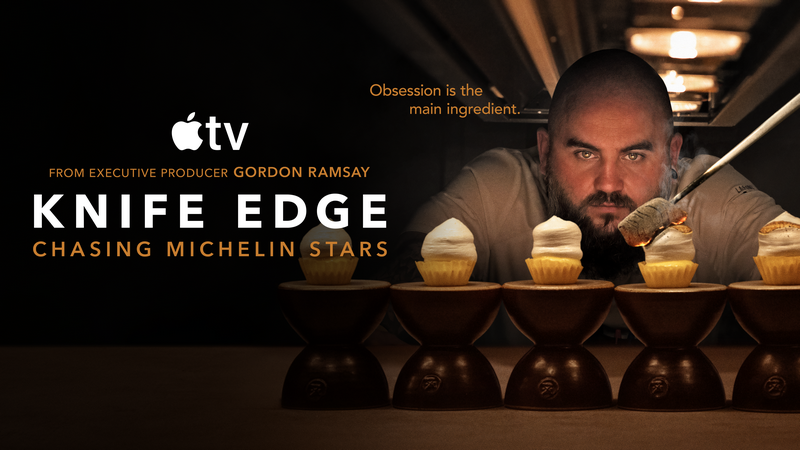
A) “Knife Edge: Chasing Michelin Stars,” for me, was an important moment to really sort of open up the door behind the scenes and get a proper insight to what is happening in these acclaimed restaurants. Also, that level of unscripted drama and following these incredible female and male chefs in pursuit of excellence was something that I’ve done for many years. And so it took me back to literally 1998 when I first opened Restaurant Gordon Ramsay and won our first star, to the second star, to winning three stars. And so I was keen to make sure that you got the real unscripted drama, the real unfolding of what it takes to perform at that level. And then not just the jeopardy, but the stakes, the financial stakes, the sort of reputation, then the desire to climb that ladder, and also, following those emotions. You know, running restaurants, yes, it’s a business. Yes, it’s incredibly difficult. But more importantly, there’s no script. Every day it changes. Every day it’s different. And so “Knife Edge” is literally giving you that incredible insight to the pursuit of perfection on a daily basis.
Q) After seeing these chefs go through the pressure, sacrifice and fear behind pursuing a Michelin star, has your own relationship with the pursuit of perfection changed in any way? Do you relate to the stress that they’re experiencing?
A) That’s a really good question. First of all, I can relate to that kind of stress. I think every career has its stress. It’s how you handle that stress. I’ve always said that that level of pressure is healthy, depending on if you’ve got the build up to handle that level of pressure. And so I thrive on pressure, and you’ll see in this incredible insight across “Knife Edge” that they also thrive on the pressure. Stress can be misconstrued in so many ways. It is a high energized, impactful industry, and yes, those stress levels are created. But that level of perfection and that kind of pursuit takes a certain individual. And you’ll see that in “Knife Edge,” that they are well trained, they are incredibly disciplined, and they are at the top of their game. And so I can relate to that in many ways. Just recently, in fact, we just celebrated 25 years at 3 Michelin star, and so I can envision myself in their scenarios. Brazil, for instance, following that incredible couple, and just what it meant to them for that level of dedication. Not just hours, weeks, months. Years of absolute driven attention to detail to get that first three-star across the country, and what it did to them, what it says for that country to be given that honor is a unique insight. And that’s just one tiny little restaurant across this incredible documentary.
Q) Through producing this series, do you look back on your experience chasing Michelin stars any differently? Is there anything you would have done differently in retrospect?
A) Good question. As an exec producer, having done thousands of hours of television for the last 25, 30 years, and I’ve been in these situations many times from one-star, two-star to three-star environment, you can understand the speed these restaurants work at, and I can help pinpoint and show the producers exactly where that kind of empathy, jeopardy, juxtaposition is going to be happening. And so 9 times out of 10, I’ve got it right. This series is knitted together beautifully by Jesse. Jesse’s got that incredible, tough job between that fine line of not upsetting the flow, dancing over the scenarios, and pinpointing sort of the customer’s perspective, and so he has a very difficult job. But I can relate to that in many ways because I’ve been there. Okay. I’ve been in their shoes. I feel for them. Part of this documentary, for me, was giving them more spotlight and more credibility that is so much more deserved. And you never understand the real makeup of a proper chef in terms of the feelings, the emotions. And you see the dish, you devour it from a customer’s perspective, but now you’ve got that whole holistic 360 view of what goes on behind the scenes, and it really is a very, very incredible eye-opening moment.
Q) What do you think of the new generation of chefs today, like the ones featured in the program?
A) I cut my cloth from France, and so I’ve got a lot to be thankful and grateful for. Today’s generation of chefs are incredibly talented, and I’ll explain why. They have the added advantage of social media. They have the added advantage of that kind of landscape, and the length and breadth of what food is doing on those social platforms, and so I think it’s an incredibly educational moment for them. There seems to be a level of focusedness of this next generation than ever before, and then you look at the ingredients, the artisanal, whether it’s a beautiful reared chicken to the best of the beef, to line-caught sea bass, to the seasonality aspect. And so there’s a want from the customer’s perspective that puts these restaurants under pressure to eat some of the best food anywhere in the world, and it comes down to the ingredients and the discipline from that chef. So, I think this is one of the most exciting generations that I’ve ever witnessed and been part of. And having a daughter, Matilda, at the age of 24, tapping into those and going off and training in other restaurants across the globe, and watching these chefs and working with them, it’s a dream because they are uniquely poised. They are focused like no other, and they have this vision with that backup of the knowledge also that is related to their iPhones. So, yeah, it’s an exciting position to be in right now.
Q) What was one defining moment when your own career was on a knife edge, and what did you learn by emerging from that?
A) Yeah, my career in the early days was constantly on a knife edge. When you’re working at that speed and pushing the boundaries out the way you are, everything becomes so high end. Everything’s just 1000 miles an hour. I think, you know, taking risks is the most important thing I did. Disappearing to France and Italy to come back to the UK at the time in the early ‘90s, to come in with something different and have a likeness to the style of food I was cooking was the most important part for me. I got that from Guy Savoy in Paris. But I can remember the night before the guide came out in London, and I’m literally half past 5:00 in the morning the next day, queuing up at the bookshop waiting for the Michelin Guide to be delivered. And then it was embargoed to midday, and then we got the news. And so winning that first Michelin star, it still feels like it was last week. And that, for any young chef in this industry today, is something that’s to be treasured. And it’s that stamp of approval that you seek, but also, you want you want the stripes and the stars. You want that level of recognition and Michelin does that in abundance.
Q) As seen in the series, Paris remains the capital of gastronomy. Which cities are able to compete with Paris today?
A) You’re going to get me into trouble on that question now, because of course, Paris is the epicenter. I lived there. I had a beautiful, tiny, little flat down the Rue de la Roquette, la Bastille. I used to go and sit outside the opera house every Sunday with my croissant and my espresso, and I would sit there thinking of the level of perfection that this city has to offer. And having a restaurant now in Versailles and being back in Paris is just the dream. Very few cities anywhere in the world match Paris. I remember being sat on that little metro with my little ticket, my orange metro card, and I would sit there with my Linguaphone on and I’d be sat on the way to the Arc de Triomphe and the 17th arrondissement, and I had been studying French. And so I still go back to Paris now, and I still can’t think of a city anywhere in the world that can match Paris. I’m going to say London. I know it’s very close. I know it’s very sort of, you know, Central Europe, but I would say London now. Maybe not for the grandeur, maybe not for the architecture in terms of what Paris stands for, but I would say London. London’s up there. New York is there. There’s no two ways about that. Everyone thinks that Paris has sort of sat on its laurels and lost its way. I disagree. It’s just it was there first. It was the foundation of what cuisine, and there’s nowhere like Paris.
Q) How do you feel cooking TV shows have evolved since you first started? What hasn’t been explored yet in this space?
A) Yeah, that’s a good question. What hasn’t been explored? Not much. “Top Chef en France” is toujours, an incredible program. Professional chefs have done exceptionally well. Chaoshan cuisine, sometimes there’s a little bit of fun element there. I think what TV has done for the industry has given a certain amount of how glamorous it is in a way that the chefs today, cutting their cloth in these incredible restaurants, has given them the platform, their respect. I think also as a marketing tool in terms of every chef knows how important that marketing is to those restaurants. And so an insight to food on TV now creates a bigger search to visit these restaurants, to tap into that level of excellence. And I think that TV culture has absolutely shone the light on some unknown restaurants that are relieved, the fact that they are now in that domain and fully booked because of that TV presence, or that insight, or that dish that had become famous overnight from that chef’s creation. So, it’s a very important marriage, the restaurant and the TV world, because it’s a very great way of seeing the restaurant at its best through that lens.
Q) Has the value of a Michelin star become more or less important with the rise of social media and online reviews?
A) Yeah, that’s a good question. I think, first of all, Michelin has a unique level of consistency when they award stars. And that’s why it’s one of the greatest guides anywhere in the world, because of the ambiguity in a way that, A), you don’t get to see these inspectors, B), you don’t socialize with them, and it’s incredibly discreet. And so these things here relate to critics as well. Everyone’s a critic when they walk into your restaurant with that. And so the Michelin gets so much more respect because they’re discreet, and the level of discretion, and how they operate. Looking at other guides, the Gault & Millau, that’s still a very trusted, incredible guide. The UK has the Good Food Guide as well, and you’ve got the New York Times, still a prolific guide running that sort of East Coast. And so we welcome those kinds of online reviews. And I’ve always said, the quicker we get the bad news, the better we can deal with those kinds of situations. So, I think that kind of scrutiny online with those kinds of comments is the benefit of these restaurants today, because it’s instant. And when they’re saying the same thing three or four times, and it is consistent with that particular dish, then you know you’ve got a problem. And that is a blessing for every chef to get that kind of insight quickly.
Q) India has restaurants that could be worthy of a Michelin star. Should the system be extended to more countries?
A) Great question. First of all, I fell in love with India years ago when I went in pursuit in Rajasthan, and just wanted to understand the true, proper breakdown of Indian cuisine. And so does it deserve the guide? 100% it deserves the guide. It was such an exciting announcement a couple years back when Dubai produced its first Indian three-star Michelin restaurant, and we have two two-star Indian restaurants across the UK. And so a cuisine that I’ve grown up to love, and there’s something quite humble. So, I have every confidence that guide will make it to India, and soon just announced in New Zealand and parts of Australia, so fingers crossed. It’d be wonderful to see that guide in India. Definitely.
Q) What do you think is the biggest challenge facing the culinary world today? Pushing the boundaries of food, or balancing creativity, sustainability, business and the human cost of working in this industry?
A) Yeah, that’s a great question. The biggest risk is the economy. These restaurants are businesses. And you can be one of the most talented chefs in the world, but if you can’t run a business, then you just become a busy idiot. And so with ever-increasing rising costs, materials, labor, etc., that all needs to be factored in. So, you know, customers understand that, and there’s a price to pay for that level of perfection. And so I think those basic understandings on how you run that business needs to be in line. The biggest message I always say to these young, up-and-coming chefs stepping out into their business for the first time, is start slowly. Become a talented neighborhood restaurant, and then become the best in the neighborhood, and then add two more in the kitchen, two more front of house, then start becoming a little bit more glamorous with your menu. But you need to be cash positive, and you have to establish a local following, and you’ve got to depend on those locals. Because everybody can fill a restaurant Friday, Saturday, but it’s a Monday, Tuesday, Wednesday, that’s the important one. So, we can’t blame the economy. We can’t keep on blaming rising costs. We just have to be smart with the expectations of what you want to do, where you want to go, and start almost slightly humbler today than you would have done because of the spiraling costs, and then keep the labor costs under control. It’s a very tough gig out there. It’s a very tough world, but there are restaurants that are starting off slowly and grow gradually. And you’ll see that with the waiting list that you can’t get in, and it’s fully booked, and then you start to go up into a different league.
Q) Today’s chefs are also entrepreneurs, TV personalities, and brands. How has the rise in mainstream popularity of chefs impacted the category?
A) I think that level of entrepreneurship is important in the restaurant business because they have to become the best marketing tool, they have to become a great leader, they have to become a great spokesman, and then they are instantly a brand literally overnight. And so, you know, today’s world, it’s much more multi-facet, and you’ve got an incredible focus on these chefs, the prolific profile. Now, I think it’s a good thing. You see it in sports, you see it in medicine, and a sports star, a football star, soccer star, basketball player can be sponsored by Nike for millions of dollars, and chefs at one of those businesses can take on that kind of partnership and be sponsored by similar brands. It’s the world we live in. It’s what’s happening on that fast-paced growth, and I think it’s healthy to see these chefs. I say to my team every time, you need to become media savvy, you need to be leaders, you need to be entrepreneurial, and you need to understand the P&L, because you’re a tangible asset, and you’ve sacrificed sometimes 10, 15, 20 years to put on a plate what you put out to customers, and you deserve the recognition for that. And I don’t think there should be any difference between a prolific NBA player, soccer star, incredible boxer, to a prolific chef. They deserve every ounce of attention, and it’s about time they’ve got that equal footing because of the slog, the work, and the hours of commitment to get to that level of perfection. You never get to see 95% of it.
Q) The series shows chefs facing enormous financial and personal pressure to achieve or maintain stars. At what point does the pursuit of excellence become counterproductive, and how can chefs protect their creativity and identity within such demanding standards?
A) Yeah, that’s a great question. Well, first of all, you’ve got to stay within your means, and you’ve got to manage your business accordingly. Don’t forget, the Michelin are there at the end of the year to confirm what you’ve just cooked for the previous year, okay? So, they give you that stamp of approval, which should then increase business and awareness locally to whether you are. But for me, the most important thing of any young chef running a business is making sure that you’re in the black. You can’t afford to follow this culinary pursuit of excellence when hemorrhaging hundreds of thousands of dollars. There are way more prolific chefs and restaurateurs out there with one star, two stars, and three stars that have become incredibly busy after they’ve been given that star, and sometimes not even on the radar. The star comes, the publicity comes, the reputation starts to build, and all of a sudden, they’ve got this business. So, it’s being realistic to where you are, and staying and working within your means, and not running too fast. But again, that pressure, sometimes I think it’s good to have that financial burden, because it keeps your feet on the floor, it keeps all your costs at a level that you don’t get too excited that you’ve got money to burn, and at the end of the day, we can’t be busy idiots. And certainly Michelin don’t want to start awarding stars to restaurants that go bust within 12 or 14 months later, so you’ve got to be smart. You’ve got to be smart. And that’s why I mentioned earlier, one of the questions that just the pressure of these talented chefs running that business, I’m fed up with that saying about stay in your lane. I always say, own your freaking lane. Own it. Bring on the best financial advisor, make sure you’ve got someone that’s running your books, understand what your cash flow means, how that dictates. Want to take a holiday? Make sure that restaurant can function with or without you. And so build those foundation blocks steadily, properly, and make sure that you’ve got one foot in the kitchen, and one foot in the business. Do not take your eye off the ball and get carried away with stardom. Look at the books, look at your payroll, look at your purchasing, and then look at your overheads. And that’s like studying a menu in business every week that you need to understand, “Okay, it’s been a great week and we’ve been #1, but financially, we’re not there yet.” So, yeah, stay within your means.
Q) In your opinion, what qualities does a Michelin star level chef possess? And are there certain skills that they must possess?
A) That’s a really tough question. The most important thing with any restaurant is that level of consistency. And so in that pursuit of excellence with a one-star, you have to be the best at what you’re doing locally. Whether it’s a seasonal menu, whether it’s a level of detail with its own personality, inspectors want to see that DNA. And then when you get to two-star, it gives another dimension. You become a very special sort of unique restaurant that stands out with pure individuality. And then when you get to that third star level, there’s a fine line between two and three stars. Then you’re in this unique sort of bracket of a real level of perfection. And so, when chefs want to start out in that industry and they want to go to that Michelin star, it’s really important for them to go into the best bistros, cafes, brasseries and understand the basics before they start going. I never set out at the beginning, in my first job at the age of 19, dreaming of a Michelin star. That was way down the path. I just wanted to understand the basics perfectly before you start taking too much on and getting too carried away, because there’s different ages until you can mature and understand what you’ve been taught. And so you’ve got to get on that treadmill, understand the basics, and then literally progress every six months and climb that ladder. So, yeah, discipline. That’s the biggest thing any Michelin star chef can hope to have in their knife wallet. All day long, discipline.
Q) What do you think is harder today, earning a Michelin star for the first time, or constantly proving you deserve to keep it?
A) Yeah, that’s a tough one. Oh dear, some chefs claim it’s boring maintaining it, and I think it’s exciting maintaining those stars. Winning it is that incredible moment you see on “Knife Edge” on this series, and those ceremonies are just like the Oscars. Everyone’s dressed. That’s the only time you get to see chefs at their smartest with black jackets and bow ties and just looking immaculate.
So, winning is exciting. I think the hardest job, if I’m honest, is keeping it. Not getting complacent, making sure you’re innovating, staying along that sort of creative side and evolution. Customers get bored quickly. They don’t ring you up and say, “We’re not coming back.” They just don’t come back. And so you have to keep creating. And I always love, when we can, moving across those seasons, coming out of summer, entering autumn, entering winter, then coming out of winter and then the first, second week of spring with the fresh peas and the fresh asparagus. And so if you can bring that seasonality aspect to it, it becomes so much more exciting, and yeah, customers love change. Customers love that innovation, and they don’t want to see the inconsistency every time they come back. They want to see it stepping up a gear each and every time.
Q) Was there anything from the interviews with the Michelin inspectors that surprised you or that you found particularly interesting?
A) No. I mean, these, honestly, when I retire from cooking, I will send my resume to the Michelin group to become an inspector. [LAUGHS] I think it’s the best fucking job in the world. Can you imagine traveling the world and all these incredible restaurants and then getting paid to eat some of the best food on the planet? I don’t know many inspectors. I’ve never been out to dinner with them. I don’t go on runs with inspectors, but they have the best freaking job in the world. Can you imagine, five nights a week, going out to some of the best restaurants in the world as your job? When the average customer is waiting two or three months, four months, five months to get into this, you do it every night. So, to answer that question, I love the anonymity of these. I love the secrecy of them. They’re like the FBI. They’re like the secret agents. And so, I’ll be honest, it’s pretty cool, by the way, if you’re at a parents’ evening and they say, “What does your mom and dad do?” “Well, they’re a Michelin inspector.” “Yeah, can you bring them into our school canteen to sort out that shit?” I think it’s the best job in the world. When I’m done with my pots and pans, I’m sending my resume to the tire company in Paris. But I tell you what, I have a fucking good palate, so I’ll be amazed if I don’t get the job. [LAUGHS]
*PRESS CONFERENCE*