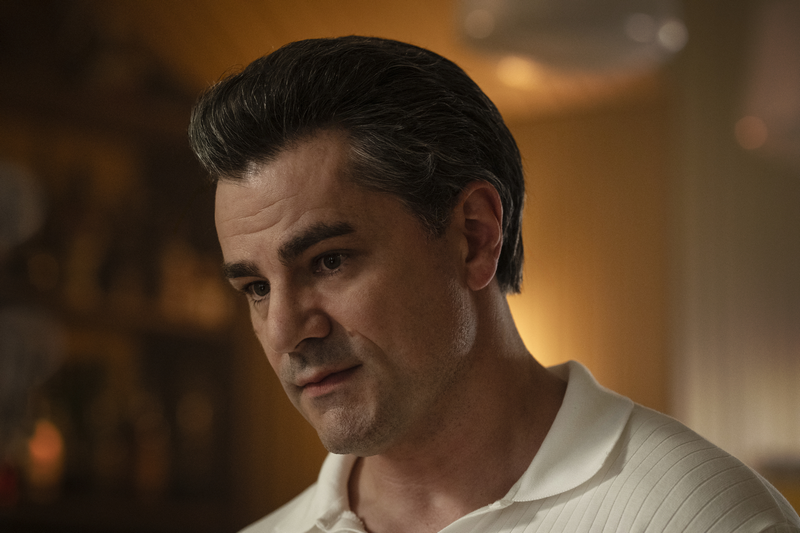
By: Kemberlie Spivey
Photo By Brooke Palmer/MGM+
Q) John Gotti is one of the most recognizable names in organized crime history. What was your initial reaction when you found out you’d be stepping into this role, and what part of preparing for him surprised you the most?
A) When I first got the audition, I was surprised. I had wanted to audition for the show but never in a million years did I think it would be to play John Gotti. Then, I actually looked at a photo and thought, “My god! This guy looks a lot like my grandfather,” so after that it didn’t seem so farfetched. When I actually booked the part, I was a little overwhelmed. And it took me a few days to come down to earth and start working. Once I started into it, I was surprised to see how much material there is about him and about that time period in New York’s organized crime history, which was great for me. So, it was just a matter of absorbing as much of that as I could. Then, when I got to set and started working with all of the department heads, hair and wardrobe in particular, Natalie [Nelson] and Anne [Dixon], things really started to click. Then, we started shooting and I met all of the guys who made up the Italian crew, Michael, Mark and Richard, the whole thing kicked into another gear. It was such a wonderful collaboration.
Q) The series is set during a pivotal moment in New York history, with the construction of the Javits Center creating enormous opportunities for organized crime. How much did immersing yourself in the politics and history of 1980s New York influence your performance?
A) Massively. I think that the culture of New York City in the 80’s plays a huge role in this series. Understanding how it worked helped me to understand the relationships these characters had with each other, how they interacted with and viewed the public. During this era organized crime was integrated into every level of daily life in New York City. Some people were more aware of that than others, but I imagine it was felt in some way by everyone in the city.
Q) The show explores power from multiple angles—not just through violence, but through influence, loyalty, and intimidation. In your opinion, what does power mean to your version of John Gotti, and how does that shape every decision he makes?
A)I think it’s important to understand that the show is historical fiction, it is not a biopic. That allows me a huge amount of freedom as an actor because I am simply basing my character on John Gotti not playing the circumstances of his life. So, I was able to pull from material about Gotti specifically as well as his contemporaries to create a point of view from which to understand the world they inhabit, which had very high stakes with dire consequences and power was everything. This power was consolidated through the relationships they built with politicians and law enforcement and other members of organized crime and held by the threat of acts of extreme violence. So, in short, power to our Gotti is everything.
Q) Your scenes often have an underlying sense that Gotti is already thinking three or four moves ahead. How did you balance portraying confidence with the insecurity that can come from someone who’s still trying to earn his place at the top?
A) I think that this version of John Gotti and from what I gather about the actual person, he always knew that he was going to be the boss. There was a sense of inevitability. Not a question of if, simply how and when, because from what I read about him, he felt he could do the job better than anyone else. So, of course, it should be him.
Q) One of the most compelling dynamics in the series is the tension between the Italian mafia and The Westies. Your character clearly questions whether working alongside the Irish gang is worth the risk. What did you find most fascinating about that rivalry and how does Gotti’s perspective evolve as the season unfolds?
A) I think at first Gotti doesn’t understand why Castellano would keep these guys around, it seems like a waste of payroll. But as the season evolves, he sees the value of having a group of guys that are not beholden to the very complex, very strict rules that govern the Italian mafia. And he wants them working for him.
Q) Gotti is constantly calculating his next move, even in conversations that seem casual. Were there moments where you intentionally played a scene with one objective on the surface and a completely different one underneath? Walk us through one of those scenes, please.
A) I heard in an interview a friend of his say that Gotti loved being a gangster. He loved his work. And he was a fighter. So, I think all of these scenes that are real chess matches, like the ones with J.K. [Simmons] or Tom [Brittney] and Stan [Morgan], the interpretation of Gotti that we have created, would have really enjoyed the sparring with those guys. Our character loved going up against people and trying to outmaneuver them. This was his work and he loved it.
Q) As viewers, we know where history ultimately takes John Gotti, but the characters around him don’t. Did knowing his eventual legacy ever influence how you approached seemingly smaller moments, or did you try to stay completely rooted in who he was at that point in his journey?
A) Because this is historical fiction I was lucky enough to simply follow the plot that Chris Brancato and Michael Pains had laid out for me, which is Gotti on the rise and his ascension to the throne. And I think he never had a doubt in his mind that he would be king. So, that informed how he dealt with people in every moment. Sort of like, “You’re gonna want to be on my good side because one day this will all be mine.”
Q) Without giving away spoilers, was there a scene this season that completely changed your understanding of Gotti? Maybe a moment where you realized there was more vulnerability, humanity, or danger beneath the surface than you initially expected?
A) I got a very concise piece of direction from Alan Taylor, who directed the first two episodes, while I was doing a scene with J.K. It really set the course for me and informed who this character wanted to be and I was able to carry it with me throughout the season.
Q) “The Westies” doesn’t paint organized crime as simply glamorous—it highlights the consequences, paranoia and constant struggle for survival. How did that more grounded approach affect the way you wanted audiences to view John Gotti compared to previous portrayals in film and television?
A) I think I was simply interested in doing justice to the world of New York in the 80’s. So, hopefully we have achieved that goal. And if that distinguishes us from other iterations of this story then that is great, but I was personally concerned with making these characters real people.
Q) Many actors have portrayed John Gotti over the years, making him one of the most recognizable crime figures in pop culture. How did you make a conscious effort to create a performance that feels uniquely yours while still honoring the historical figure audiences think they know?
A) As I said before, I am so lucky because this show is not a Gotti biopic, so our character is based on Gotti without having to play out the actual circumstances of his life. Everything that happens on our show is an extrapolation of what these relationships and interactions may have been like. So, the guys who played Gotti in previous stories had a much harder time of it than I did. Also, I was in such good hands on this show with the writing, the art department and the other actors so we all created this character together. So, having to find a way to make our Gotti distinct never crossed my mind. It was simply about doing justice to the story and the people whose lives this show is based on.
Q) What did you take away as an actor or as a person from working on this series?
A) Recreating New York in the 80’s takes a huge amount of dedication and attention to detail. Everyone in the crew, the creative team, the other actors that I worked with on this show, were very supportive of each other and of me. So, I learned a lot about trusting that collaborative process going forward.
Q) What are the other upcoming projects that you’re excited about that we should keep our eyes on?
A) We just wrapped up on “Daredevil: Born Again” Season 3 which I think people are really going to enjoy.
Q) What would you like to say to fans and supporters of the wonderful work you continue to do on our screens?
A)Just thank you so much for your support. I really appreciate it. I am always so grateful and wonderfully surprised that people enjoy the work. So, thank you.