By: Kelly Kearney
Photo By Julian Lomaga
What if closure could be manufactured? What if technology could recreate the people who hurt us most and give us one final chance to say everything left unsaid? Director Alexander DeSouza and writer Alexander Hernandez-Maxwell explore those questions in the 2026 Tribeca Film Festival short film submission Holo. The movie is a thought-provoking sci-fi short that turns grief, trauma and healing into a corporate service–a world we are quickly evolving into. Running just over twelve minutes, Holo presents a future where artificial encounters replace human connection, asking whether technology can truly help us heal or if some wounds are simply too deep to be treated by a machine.
Closure is Big Business
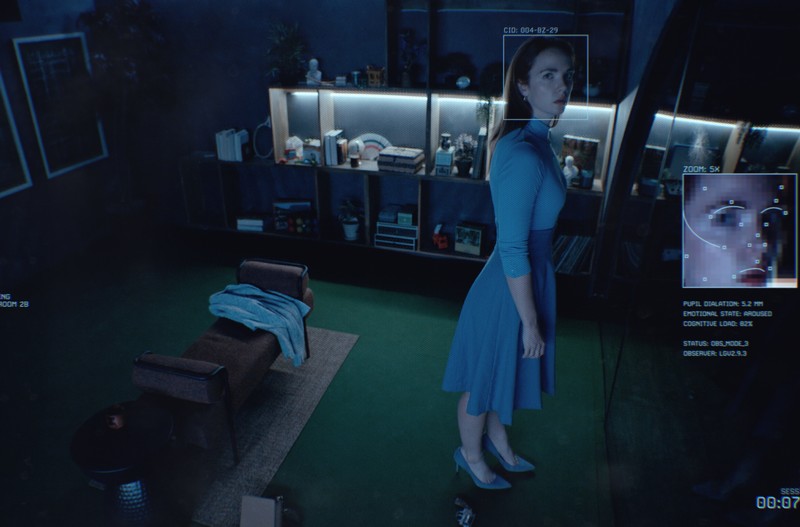
When her abusive partner Jared (Shane West) dies, Claire (Morgan Kohan) turns to Looking Glass Technologies, a controversial company that allows clients to interact with digital recreations of the deceased. Separated by a pane of glass, Claire comes face-to-face with a holographic version of Jared in hopes of finding the closure she never received in life. Behind the illusion is Grey (Zelda Williams), an employee who uses motion-capture technology to embody Jared. As Claire attempts to reclaim control over her past, Grey struggles with the emotional burden of bringing an abuser back to life. Through their uneasy interactions, the film examines abuse, grief and the growing role technology could play in mediating deeply personal experiences.
Visually Holo is stunning. The cinematography from Julian Lomaga and production design from Jasmine Asiedu-Anguah and Magali Lafleur create a world that feels sleek, sterile and emotionally detached. The glass separating Claire from Jared becomes more than a physical barrier as it symbolizes the distance between victim and abuser, memory and reality, human emotion and artificial reconstruction. Reflections dance across the glass throughout the film, sometimes warm and inviting, other times harsh and invasive, mirroring the emotional shifts taking place inside the room. The monochromatic design of Looking Glass Technologies reinforces the company’s inhuman approach to the very human process of healing. Every detail, from the lighting to the holographic effects, feels carefully controlled – creating a world where trauma has become a commodified service.
In an A.I. World, Human Actors Are the Stand-Outs
The performances are what truly elevate the film. Morgan Kohan delivers a layered and emotionally raw portrayal of Claire. At first there is almost a sense of relief and comfort in seeing Jared again, but as the conversation unfolds years of pain, fear and anger begin to surface. Kohan allows those emotions to emerge naturally, making Claire’s journey feel authentic and heartbreaking. There are times when words are lost and fear washes over Kohan’s face, building a backstory for viewers to measure the weight of this interaction. Zelda Williams is equally compelling as Grey, balancing the technical demands of her role with genuine empathy. Her discomfort with the job and concern for Claire’s wellbeing add another layer to the story. Shane West has the difficult task of making Jared both charming and terrifying and he succeeds. His performance shifts effortlessly between warmth and menace, reminding viewers how abuse often hides behind charisma.
DeSouza’s direction is particularly effective in the way it controls the film’s pacing. The story begins quietly, almost cautiously, before unraveling in a rush of emotion. Every aspect of the production feels meticulously designed, from the sound editing to the lighting changes that subtly influence the mood of the encounter. The film draws comparisons to series like “Black Mirror” and “Severance,” using a futuristic premise to explore very human pain. Yet Holo never loses sight of its central question: Can artificial intelligence offer genuine comfort or does healing require something technology can never replicate?
Plenty of Story Left To Tell
As a proof of concept, Holo leaves a strong impression. Its world-building is rich enough to suggest stories beyond this single encounter, and the connection that develops between Claire and Grey hints at emotional territory the short only begins to explore. More importantly, the film raises uncomfortable but fascinating questions about turning grief and trauma into a business. In a future increasingly shaped by artificial intelligence, Holo imagines a world where healing can be purchased, managed and controlled. Whether that future is comforting or terrifying is left for the audience to decide. What is certain is that this smart, visually striking short leaves viewers wanting to spend more time in the world of Looking GlassTechnologies and discover where its reflections lead next. If you enjoy bleak, dystopian, peeks into what could be our future then Holo is a watch you should not skip.