By: Jamie Steinberg
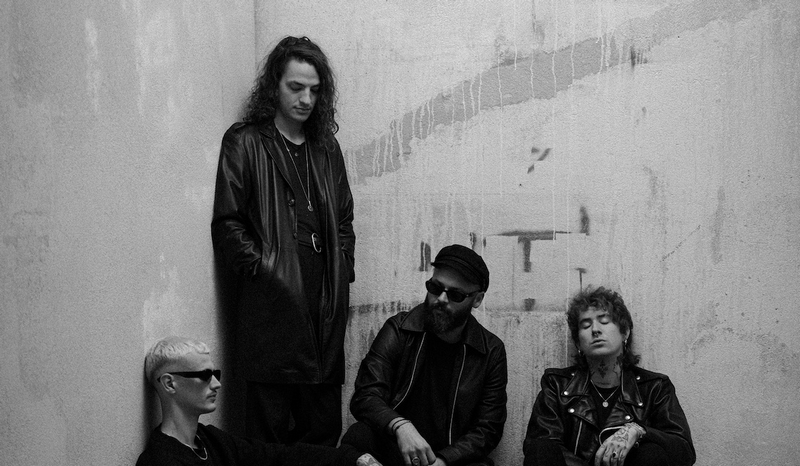
Photo By Margaux Fazio
Q) Your music is often described as synth pop or post punk, but how would you describe your sound?
A) I’d honestly rather let other people define it for us, but if we had to choose just one, I guess New Wave probably makes the most sense. It’s broad enough to include a lot of the other genres and influences that are part of our sound.
Actually, beyond the genre itself, I think we tend to think much more in terms of imagery. If someone told me tomorrow, “Your music is blue and it makes me think of walking through the city at night in the rain,” I’d totally get what they mean.
Q) Who are some of your musical influences?
A) We all come from pretty different musical backgrounds in the band. Romain, our drummer, grew up listening to Linkin Park and Depeche Mode and over the years became a huge Nine Inch Nails fan in particular. Jim, our bass player, is a child of Britpop and British rock more generally — a big fan of The Beatles, Oasis and The Stone Roses. Glenn, our guitarist, was exposed to rock and New Wave from a very young age with bands like The Cure, Cocteau Twins and The Smiths, but also Radiohead and Bloc Party when it comes to more recent stuff.
As for me, I grew up listening to quite a lot of Michael Jackson and I was a massive Jim Morrison fan. Then, I discovered Factory Records and really went down the rabbit hole with Joy Division and New Order. In more recent years, The National has naturally remained a bit of an obsession for me. They somehow manage to fit so many of my moods and I really love the poetry in the stories they tell.
Q) Talk about the story behind your new song “Nocturnal Vision.”
A) This song is about a love that’s grown stale and maybe a little desperate, too. The image I had in mind was of a drunk guy wandering through the streets of some unnamed city, making these sad but strangely matter-of-fact observations about someone who probably doesn’t love him anymore.
It’s really about that moment when passion starts to fade and a relationship becomes more about the work of keeping it alive and the grieving process that can come after that — all against this backdrop of manipulation, lies and intoxication.
Despite the sadness of the subject, there’s also something quite light about the song, which I find almost funny at times.
Q) What do you think it is about the song that fans connect to?
A) I don’t think a songwriter can ever really anticipate what’s going to connect with someone in their songs. I’m constantly surprised, actually, by the reasons people give for connecting with our stories. They’re different every time and that’s exactly what I find fascinating about it.
The song taps into a kind of very common despair — drowning your sorrows in alcohol after having your heart broken. So, I guess we’re being listened to by a bunch of drunks. [laugh] I’m kidding, of course. I think there’s also something slightly romantic about hurting yourself when you’re already hurting. We’ve all had our hearts broken at some point. Beneath all the colourful synths, that’s really what this song is about.
Q) What are some themes you will be exploring on your upcoming debut album Knots & Chains?
A) The album mainly explores the idea of control, in all its different forms — the control others have over us, the control we impose on ourselves and even the control certain places can have over us.
We thought of the album almost like a living organism, a kind of movement from suffocation towards openness. We’ve always been drawn to the idea of contrast in everything we’ve done so far. Within that chiaroscuro, we really try to take the listener from despair to hope and back again.
Q) What is your song writing process? Do you need music before you can create lyrics?
A) Yeah, I very often need some kind of musical canvas, some sort of context, to find the words. So, more often than not, the music ends up guiding my writing and pushing me towards figuring out what I actually want to talk about.
I like thinking about composition as if I’m just a vessel, happily being wherever I am, playing whatever I’m playing and waiting to catch the idea that lives somewhere in a chord progression or a particular sound. Or, in another sense, I like the idea that music can be a form of catharsis for things we wouldn’t know how to work through otherwise.
For me, our songs are a bit like little bubbles where I’ve tried to make sense of things, to ask myself questions. And the feeling of knowing you’ve written a good song is incomparable to anything else. It’s just the best feeling.
Q) How much of a hand do you have in the production of your music?
A) We have complete control over everything we produce. That’s obviously a great thing because it means we can do whatever we want, but it also becomes a real challenge because we don’t always have enough perspective on what we’re making.
We’re definitely not opposed to having a fifth brain in the room, someone who can say, “This is cool,” or “Maybe this isn’t working.” There’s something really exciting about putting our music, or even the way we make music, in someone else’s hands and seeing what they bring to it.
Q) My favorite tracks on the album are “Call of the Swift,” “Fantasy” and “The City Works Like This.” Which of the songs off Knots & Chaos hold a special place to you?
A) They all have a special place, of course. But I have to admit, “Call of the Swift” probably stands out a little more. First of all, because it opens both our album and most of our shows, but also because through its lyrics it captures a part of my life that I’d either forgotten about or maybe wanted to forget, probably as a way of protecting myself. I guess I like it precisely because it makes me feel particularly vulnerable.
Q) What can fans expect from a live Lone Assembly performance?
A) I think people can expect a slightly more organic and rock-oriented version of the songs live. There’s definitely a bit more energy and power on stage than there is on the records and I think that’s something we really enjoy. We’re not trying to just reproduce the album as it is, either. Some songs evolve quite a bit live and we like giving them a different feel or bringing out things that maybe aren’t as obvious in the studio versions.
But beyond that, I think there’s a real emotional side to our live shows. These songs are quite personal to us, so playing them in front of people creates a different kind of connection. And I think there’s something really special about that moment when the intimacy of the songs meets the energy of the band playing together on stage. We genuinely have a lot of fun playing together and, hopefully, people can feel that. I guess that’s what we’re looking for more than anything — for the songs to feel alive.
Q) What do you hope listeners take away from listening to your new EP as a whole – either as a message or emotion?
A) I think I just hope they’ll come back to it. Because when we really love something, we tend to revisit it, to listen to it again and again, to dissect it. I wouldn’t want to impose a particular lesson or a moral on the album, assuming there even is one. I think we all associate an album with a particular moment in our lives — whether it’s a disappointment, a success, a trip, a breakup, whatever it might be. And that’s what I find so fascinating about an album you love. At some point, you make it your own.
Q) Where are some of your favorite places to perform and what makes those locations so significant to you?
A) At this point, I think we’ve all been really marked by playing at Wave-Gotik-Treffen in Leipzig in 2025. It was the first time we’d found ourselves playing in front of that many people and, on top of that, it was an audience that really knew the scene, at a festival with such an international reputation. But I have to admit that, personally, playing inside FAC 251 in Manchester felt completely surreal. There are some places where you can really feel the weight of history and this was definitely one of them. I just felt incredibly lucky and grateful to be playing there, especially in a city that I love.
Back home in Switzerland, I feel like our show at Caves du Manoir in 2024 was a turning point for us. It was the first time we all felt that something was really happening between us on stage — that we were comfortable, that we belonged there. It was just a really beautiful night.
Q) What songs off Knots & Chaos are you looking forward to performing live? Maybe “You’re Pulling at the Same Strings?”
A) Absolutely. We love playing it live as well because it’s probably the song in our set that plays the most with dynamics, going from very quiet moments to much more intense ones. There’s a lot of emotion and fear packed into that song. Vocally and in terms of energy, it’s by far the one that asks the most from me.
“In the Open” is also a real highlight of our live shows. I feel like our audience has kind of turned it into an anthem and that means a lot to me because the song was inspired by my mother. So, I’m always ridiculously happy to see so many people celebrating my mum with me at our shows, without even knowing it. We should celebrate mums more — it’s important.
Q) Who would you most like to collaborate with on a song in the future?
A) Romain would probably say Depeche Mode or Kelly Osbourne. Glenn definitely wouldn’t say no to working with Boy Harsher or Chelsea Wolfe. Jim would probably go with Black Rebel Motorcycle Club. And, as for me, I’d absolutely love to collaborate with Aimee Mann, Victoria Legrand or Sharon Van Etten.
Q) What artist/musician are you currently listening to and why do you dig them?
A) Lately, I’ve been listening quite a lot to the latest albums from Interpol and The Twilight Sad. Both are absolutely amazing. My tastes and what I feel like listening to tend to change pretty often, to be honest, but these past few days William Basinski has been on heavy rotation. It’s pure ambient music, these endless loops of melancholy with no words. His music somehow reconnects me with memories that make me feel good and I think I just need that at the moment.
Q) What would you like to say to everyone who is a fan and supporter of you and your work?
A) I’d tell them to look forward to 2027. We’ve got quite a few exciting projects coming up, with some really great people we can’t wait to work with. And we’re also really looking forward to meeting our American audience whenever we get the chance, of course.
All Question Answered By Frontman Raphaël Bressler