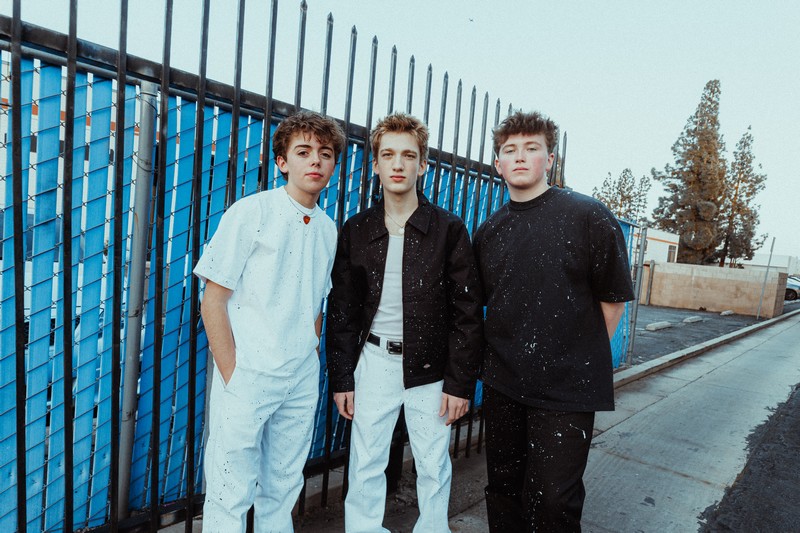
By: Lisa Steinberg
Photo By Maxine Baker
Q) Your music is often described as rock, but is there a way that you guys prefer to describe your sound?
A) We usually just say it sounds like Riff Wood. Rock is probably the easiest way to describe it, but we don’t really want to box ourselves into one specific genre. There are definitely pop-punk, alternative, classic rock and pop influences in what we do and we like being able to move between those sounds depending on what a song needs. Hopefully, when people hear a Riff Wood song, eventually they’ll just recognize it as us.
Q) Who are some of your musical influences?
A) Green Day and The Beatles have probably been two of our biggest influences since we first started playing together. But there are a ton of others: Radiohead, The Police, Led Zeppelin and a lot of different music we grew up hearing from our parents. We try to pull things we love from all kinds of different eras rather than only listening to bands that sound like us.
Q) Talk about the story behind your new song “Run It.”
A) “Run It” actually started with the riff. We were playing around with it and somebody basically just said, “Run it!” That immediately felt like what the song was supposed to be about.
The whole idea became doing something without hesitation – just go for it, don’t overthink everything and see what happens. Musically, it’s also a little heavier and different from some of the stuff we’ve done before, which made it really fun for us. Then, we added that riff at the very end separately, and it ended up becoming one of our favorite parts of the song. Fans seem to really respond to that part live too.
Q) I love the guitar riffs. Was that something that you all worked out together or a bit of improv that wound up fitting perfectly?
A) A lot of it was actually pretty organic. For the verse riff, Carson [Groves] was just messing around with ideas for maybe five minutes, played something and it was basically like, “Yep, that’s it.”
That happens a lot with us. You can spend hours trying to force something and get nowhere, and then somebody plays something almost by accident and everybody immediately knows it belongs in the song. We’ve learned not to overthink those moments too much.
Q) What do you think it is about the song that fans connect to?
A) Probably the simplicity of the message. Everybody has something they’re scared to do or something they keep overthinking. “Run It” is basically saying sometimes you just have to stop worrying about everything that could go wrong and do it.
It’s also just a really fun song. It has a lot of energy, the riffs are heavy and it’s one of those songs where you can kind of turn your brain off for a few minutes and just go with it (which is pretty much what the song is telling you to do anyway).
Q) “Run It” is another standout single from your upcoming sophomore album Butterfly in Black & White. What are some themes you’ll be exploring on it?
A) A lot of the album is about trying to find something positive when things aren’t necessarily going the way you want them to. The title Butterfly In Black And White represents that idea of duality: good and bad, highs and lows, black and white and realizing that all of those things are part of life.
There are songs about insecurity, relationships, loss, negativity and just trying to understand yourself and the world around you as you get older. We also spent a lot of time thinking about the order of the songs. We wanted the album to feel like a journey when you listen from beginning to end, rather than just a collection of songs.
Q) What is your song writing process? Do you need music before you can create lyrics?
A) Most of the time, melody comes first. Somebody will come up with a guitar part or melody that creates a certain feeling and then that feeling usually connects us to something we’ve experienced or something happening around us. The lyrics start coming from there.
But there really aren’t rules. “Manufactured Tragedy” was almost the opposite – the concept and lyrics came first and then we built the music around them. We’ve learned that if an idea is good, it doesn’t really matter how you get there.
Q) I know that Rob Cavallo lent a hand with production for the album, but how much of a say does Riff Wood have when it comes to the production of your music?
A) A lot. Rob and Joey Cavallo have been incredible about letting us be ourselves and bringing our own ideas into the studio. At the same time, we obviously understand that we’re seventeen-years-old and Rob has made some of our favorite records ever, so when he has an idea, we listen.
That’s probably one of the coolest parts of working with them. It never felt like somebody was taking our songs and turning them into something else. It was more like they were helping us figure out how to make the songs we already heard in our heads better. We experimented with different guitar sounds, pedals, effects, drum sounds and things we probably wouldn’t have tried on our own. We learned a ton making this record.
Q) “Shy Guy” and “Manufactured Tragedy” are a couple of my favorite songs on the album. Which of the songs on Butterfly in Black & White holds a special place in your heart and why?
A )For Hyrum, it’s “Down To Nowhere.” It was really fun to write, but there are also things in the lyrics that he thinks are probably going to mean even more to him when he’s older and can look back on this period of his life.
For Carson, it’s “Manufactured Tragedy.” It came from thinking about experiences that pretty much everybody goes through in relationships and life and how easy it is to focus entirely on what went wrong instead of recognizing the good that came from it, too.
For Shredder, it’s “Butterfly In Black And White.” He really connects with the whole duality idea behind the song, and the drum part was something he had to work at before it finally clicked. That process of struggling with something and eventually getting it where you want it actually fits the meaning of the song pretty well too.
Q) What songs off this upcoming album are you looking forward to performing live?
A) “Run It” is definitely one of them because it has so much energy live, especially when we get to that ending. “Manufactured Tragedy” has also been really fun because people connect with it and sing along.
But, honestly, we’re excited to start playing more of the album once everyone has had the chance to hear the whole thing. One of the coolest feelings is playing a song for the first time and then coming back to that city later and suddenly everybody knows the words.
Q) What do you hope listeners take away from listening to it as a whole – either as a message or emotion?
A) That’s really what the “Black And White” idea means to us. There are going to be bad things and good things and sometimes you don’t really understand why something happened until much later. We don’t want to tell people how they’re supposed to interpret every song, though. Some of our favorite music means something completely different to us than it probably did to the person who wrote it.
If somebody can listen to this album and find their own meaning in it (or just feel a little less alone because one of the songs describes something they’re going through) that would mean a lot to us.
Q) You guys are currently out on tour. Where are some of your favorite places to perform and what makes those locations so significant to you?
A) There were so many on this tour that it’s hard to pick.
Hyrum would probably say San Francisco. It was our first time playing there, the city was beautiful and the crowd was amazing. Carson loved Washington, D.C. It was another city we’d never played before, we felt like we played a really good show and the fans were awesome.
Toronto was a huge one for all of us. It was our first time playing in Canada, we got to explore and see Niagara Falls and it ended up being one of the best crowds of the entire tour.
And for Shredder, probably Los Angeles. Getting to play the Troubadour was really cool just because of how much history is in that room, but we also had friends and people from our team there, so it almost felt like a hometown show away from home.
Q) Who would you most like to collaborate with on a song in the future?
A) Djo would be really cool. We’re big fans of what Joe Keery does musically and we think having him feature on a Riff Wood song could make something really interesting and different.
We’ve also been on an Oasis kick lately after watching their concert film, so if we’re allowed to completely dream here, doing something with Oasis would obviously be insane.
Q) What artist/musician are you currently listening to and why do you dig them?
A) We’ve been listening to a lot of different stuff, but Oasis has definitely been in rotation lately. We recently watched the Oasis Don’t Look Back In Anger film and it reminded us how huge those songs feel while still being pretty simple at their core.
That’s something we really admire in music, when you don’t need a million things happening for a song to feel massive. A great melody, great guitars and something people can sing together can be enough.
Q) What would you like to say to everyone who is a fan and supporter of you and your work?
A) It’s still crazy to us that people come to shows, wait in line for hours, make us gifts, learn the lyrics, travel to different cities and become friends with each other because of this band. We started doing this when we were eleven-years-old because we thought being in a band sounded fun. We never imagined it turning into this.
So, thank you for believing in us and growing up with us. Come see us live, keep being awesome to each other.