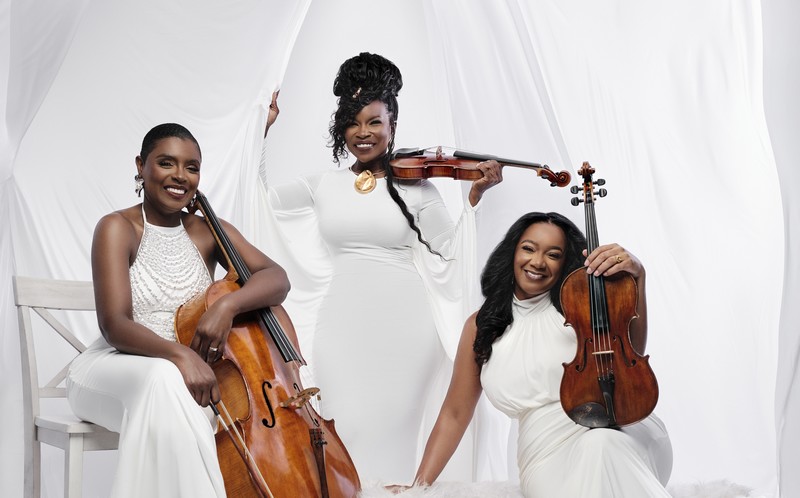
By: Karen Steinberg
Photo By Roy Cox Photography
Q) Your music is often simply described as “orchestral,” but how would you describe your sound?
Dawn: I would describe our sound as a soul-filled conversation. We blend the discipline and beauty of classical music with the sounds that have shaped our lives. We play everything from jazz, gospel, R&B, pop, soul and beyond. Rather than fitting into one genre, we see ourselves as musical storytellers. Every arrangement is an opportunity to honor where the music comes from while also bringing our own experiences and perspectives to it. We want listeners to hear something familiar, discover something new and, most importantly, feel something genuine. At the heart of everything we create is a desire to bring people together, spark meaningful conversations and remind us that music has a unique ability to connect us across backgrounds, generations and experiences.
Q) Who are some of your musical influences?
Kendall: I have been influenced, especially in my early years, by the great power belters/singers of the past – folks such as Whitney Houston, Mariah Carey, Chaka Khan and Yolanda Adams have all inspired me as a vocalist and musician. As a singer myself, my violin playing is very much mirrored after the human voice. I hear as a singer and, thus, I play as a singer. Then, you have other greats like Stevie Wonder, Michael Jackson and Prince – all dynamic, one-of-a-kind instrumentalists and performers that have left an indelible mark on our society and on my personal, musical schema.
In terms of violin playing, NEA Jazz Master/jazz violinist Regina Carter has inspired my own playing, as well as the way we approach contemporary string playing as a group. When Dawn, Élise and I were learning our instruments as little girls, there were very few teachers – let alone professional players – who looked like us. When it came to playing non-classical, Regina [Carter] and a few others were pioneering the art form in those formative years. From then on, we each saw ourselves in Regina and others, and we knew musical excellence wasn’t out of our reach.
Nine years since forming The String Queens, we’ve been blessed to have Regina serve as a mentor to us and, most recently, she has taken on the role of co-producer for our next album. We are proud to say we are classically trained string players who play with vigor and soul; unlimited by the confines of genre definition.
Q) Talk about the story behind your new song “Troubled Liberty.”
Kendall: After three albums and a couple of singles (all cover songs), we knew it was time to create original music. As artists, we believe that we should reflect the times we are living in, so we knew that would be the lens we’d present from.
We typically rehearse at one of our homes and on the first day of composing “Troubled Liberty,” (it didn’t have a title at the time), we happened to be in Dawn’s basement.
As the song begins, you hear the meditative and haunting drone from the cello, which sets the scene for what is to come. Over top of the drone, the violin enters with a somber performance of a “My Country Tis of Thee” excerpt, followed by the viola’s entrance of “Wade in the Water.” Right away, the listener can hear dissonance and struggle, but also a sense of peace. Our goal was to have listeners find their own imagery – whether that imagery is reflective of the past, present or future is up to the listener.
As the piece continues – we knew we wanted to move the tempo to a more urgent pace. We thought of Harriet and her heroic, yet dangerous expedition. We thought of not only the fear she may have had but also the audacity, the love, and the hope she must have had for her people.
When the “bridge” enters, all of the previous musical ideas in the piece are brought to a triumphant and hopeful peak. It’s almost as if this point in the song is where we proverbially “join hands” with both our ancestors and future generations to utter, “I know the road may seem rough and uncertain, but we will get to the other side of this. We have reason to hope!”
At the piece’s end, the viola returns to the “My Country Tis of Thee” melody, reminding listeners of all we have endured, faced, and accomplished; even while there is yet more work to be done.
Finally, I’d like to share that the title of the piece was a collaborative effort! Once we finished the composition, we began playing it on our tours, and we would ask audience members to suggest titles to us! “Troubled Liberty” was the end result of collecting ideas and titles from our gracious audiences.
Q) What do you think it is about the song that fans connect to?
Dawn: I think people connect with the honesty and integrity of the song. There’s a vulnerability in the music that doesn’t shy away from the complicated realities of freedom, justice and what it means to keep hoping when the world can feel incredibly heavy. While the piece is rooted in our own experiences, the emotions behind it, from hope, perseverance, frustration, resilience and ultimately our shared humanity, are universal. I think listeners can hear themselves somewhere in that journey and hopefully the music reminds us that even through our differences, there is still so much that connects us.
Q) Why was it so important for you to release the single on Juneteenth?
Élise: Juneteenth felt like the right day because it’s both a celebration and a time for reflection. It honors freedom while also reminding us that the pursuit of justice and equality is ongoing. Our new single, Troubled Liberty, captures themes of resilience, hope and perseverance in the face of adversity.
Releasing it on Juneteenth was our way of honoring the significance of the day and adding our voices to a conversation that’s still deeply relevant. We hope the song encourages people to reflect on where we’ve been, appreciate how far we’ve come and remain committed to building a better future together.
Q) The composition opens with a thirteen second audio clip of poet/author/activist Nikki Giovanni. How did the three of you come to connect with this inspirational individual?
Élise: We were truly blessed to have opened for Nikki Giovanni at a professional development seminar where she was the guest speaker. This was during COVID, when live performances had come to a halt and the organization we worked for asked us to provide a recorded performance for the event.
After our performance ended, Ms. Giovanni shared her reflections during the seminar and compared us to the incredible trailblazing women Katherine Johnson, Mary Jackson and Dorothy Vaughan, whose brilliance and perseverance helped shape America’s journey into space. Hearing her words in that moment was something we will never forget. We were deeply honored and honestly a little stunned.
Having Nikki Giovanni’s voice be the first thing listeners hear on “Troubled Liberty” felt incredibly fitting and meaningful. Her words, her legacy and her unwavering commitment to truth and justice beautifully reflect the spirit behind this piece.
Q) How does the video for the track play into the message behind it?
Kendall: The video is the visual backdrop for the composition. We very intentionally wanted to include the following elements: the MLK Memorial, a ballet dancer (a former high school student of mine), water (in this case, the Tidal Basin), a forest or wooded scene and children.
Given that we live and educate children in the capital of our country, we felt it appropriate to use certain landmarks as our canvas or tapestry. Dr. Martin Luther King Jr. is a forever giant in our culture and in our society. We wanted folks to envision his dream, while hearing our composition as perhaps the unfinished work of his dream for freedom. The forest and specifically the trail in the forest scene helped us drive home both the eerie stillness and urgency of Troubled Liberty. A small bridge is seen near the trail and it made us think of our nation’s journey and the journey we travel daily as Black women in this country. Towards the end of the video our violist Dawn is seen approaching the MLK monument, hand-in-hand with her daughter and holding her son; thus symbolizing that hope is an ever-present feeling even in uncertain times. Woven throughout the video, we see a lone ballerina, articulating every beat while also somehow showcasing the human experience.
It is our prayer that people walk away inspired, uplifted and hopeful upon watching the music video.
Q) Your album What We Carry comes out soon. What are some themes you explore on it?
Dawn: What We Carry explores our shared human experiences: identity, joy, resilience, love, grief, healing and hope. Each piece reflects something we’ve carried individually and collectively, whether it’s our history, our relationships, our communities or our dreams for the future. We wanted the album to acknowledge both the beauty and the weight of those experiences while reminding listeners that none of us carries them alone. At the same time, we wanted to make space for joy, to celebrate the moments that sustain us and for hope, which gives us the courage to keep moving forward, even in the face of uncertainty. At its core, the album is an invitation to reflect, to connect more deeply with one another and to recognize that our shared humanity is often our greatest source of strength.
Q) What is the process for working out the arrangements for the songs and making sure each person feels seen/heard?
Élise: Collaboration is at the center of everything we do. We bring ideas to the table, listen openly and respect each other’s creative perspectives. Often, one idea sparks another and the music begins to take shape through that shared process.
Our rehearsals are recorded so that we can listen back with fresh ears and continue to refine the arrangements. Sometimes we add to an idea, sometimes we remove something and sometimes we save a thought for another time or another piece.
The most important part of our process is that everyone’s voice is valued. We trust and respect each other as artists and we believe our music is stronger because each of us has the opportunity to contribute and be heard.
Q) How much of a hand do you have in the production of your music?
Kendall: We have a tremendous hand in producing our recorded music and our concerts. We’ve worked with wonderful producers for past projects, but something about this next one called us, as TSQ, to the front as producers for the very first time! We decided to embark on such a journey because no one knows The String Queens sound better than Dawn, Élise, and I. With the generous help of and gentle nudge from Regina Carter, our co-producer, it was simply time for us to take on a new level of boldness with this new music. Outside of producing, we arrange every single tune we perform and record.
Q) What do you hope listeners will take away from listening to your new album as a whole – either as an emotion or message?
Élise: When listening to our album as a whole, we hope listeners feel like they’ve been on a journey. The album doesn’t shy away from life’s harder moments, but it also doesn’t leave you there. It takes you through a wide range of emotions, creating space to feel, reflect and reconnect with what matters most.
Our hope is that people walk away encouraged and inspired – that even through life’s complexities, there’s still beauty to be found, resilience to embrace and reasons to keep moving forward. If someone finishes the album feeling a little more hopeful and a little more connected than when they pressed play, then we’ve accomplished exactly what we set out to do.
Q) You’ve performed at such places like The Kennedy Center, Carnegie Hall, and the Hollywood Bowl. Where are some of your favorite places to perform and what makes those locations so significant to you?
Kendall: Collectively, Hollywood Bowl was definitely one of our favorite places to perform – mainly because it was the biggest crowd we’d ever performed for – 17,000. For that particular performance, we were opening for the great Diana Krall and we are so grateful to have been so warmly received by the Hollywood Bowl audience! We were also new to the Los Angeles entertainment scene, so being in that space was a dream come true.
Another great stage we’ll never forget is NPR’s Tiny Desk stage. We were blessed with the opportunity to perform alongside Coco Jones for her Tiny Desk Concert! Performing with world class musicians and being featured by a gem like Coco is something we will never forget.
Q) Who would you most like to collaborate with on a song in the future?
Dawn: We dream big because we believe music has no boundaries. We’d love to collaborate with artists who are fearless storytellers and who pour every fiber of their being into their craft. Jon Batiste immediately comes to mind. We were classmates at Juilliard and it’s been inspiring to watch the creativity, authenticity and joy he brings to everything he touches. He has a remarkable ability to build community through music, and that’s something we deeply value.
We’d also love to do more work with Coco Jones. She’s leading the way for a new generation of Black women in R&B with such poise, confidence, artistry and vocal precision. We had the opportunity to perform with her on NPR’s Tiny Desk and collaborating on original music together would be incredibly special.
Artists like Raye and Beyoncé also inspire us because they continue to raise the bar creatively while remaining deeply committed to their artistry. We dare to dream, so why not? We want to create with people who are pushing boundaries and making meaningful contributions to music and culture.
Beyond recording artists, we’d love to collaborate with companies like Alvin Ailey American Dance Theater and Dance Theatre of Harlem. Movement and storytelling are such natural partners, and we can easily imagine our music coming to life through dance.
And one of our biggest dreams is to perform with some of the world’s leading orchestras. We’ve created orchestral arrangements of much of our repertoire and we’d love to be welcomed into the symphonic space to share these works with audiences around the globe. Bringing together the richness of the orchestra with our unique voice as The String Queens feels like a natural extension of our mission to connect people through music.
Q) What artist/musician are you currently listening to and why do you dig them?
Élise: Funny you should ask! Right now, NEA Jazzmaster Regina Carter is in my ear. Some people may not know this, but Regina is our mentor, co-producer of What We Carry and so much more.
Her playing is soulful, effortless and unapologetically herself. She makes the violin sing in a way that is both captivating and deeply moving. I’m constantly inspired by her creativity, especially her improvisation. It always feels thoughtful, fearless and completely authentic.
Listening to Regina’s recordings is inspiring and experiencing her perform live is electrifying. She has such a remarkable relationship with her instrument and the joy, freedom and confidence she brings to every performance encourages me to keep growing as a musician.
Q) What would you like to say to everyone who is a fan and supporter of you and your work?
All: First and foremost, THANK YOU! Thank you for believing in us, showing up for us, sharing our music and allowing it to become part of your lives. We never take your support for granted. Every concert you attend, every song you stream, every message you send and every story you share reminds us why we do this work.
Our mission has always been bigger than performing beautiful music. We want to create experiences that inspire hope, foster joy, encourage meaningful conversations and bring people together across differences. Knowing that our music has been part of your celebrations, your healing, your classrooms, your families and your everyday moments is the greatest gift we could ask for.
We hope you’ll continue this journey with us as we keep telling stories through music, building community, and reminding one another that our shared humanity is far greater than the things that divide us. Thank you for carrying this mission forward with us. We couldn’t do it without you.